Love this? Save it for later!
Share the inspiration with your friends
Thanksgiving dinner was in twelve hours and I’d completely forgotten to defrost the turkey. Not just forgotten—I mean, I’d bought the bird four days ago, shoved it in the freezer, and then promptly lost track of time while testing pie recipes for the blog. Everyone else in my family would be bringing their signature dishes: my sister-in-law’s legendary green bean casserole from scratch, my mom’s cranberry sauce with the whole oranges floating in it, and my brother’s twice-baked potatoes that take him three hours. I had a rock-hard turkey and a growing sense of panic.
Honestly, I was ready to order pizza. But then I remembered this herb butter recipe my neighbor Carol had scribbled on a napkin last summer. She’d said something about it being “idiot-proof” and “the only turkey recipe you’ll ever need.” Desperate times, right? I grabbed the butter, raided my spice cabinet, and prayed. Let me tell you—that bird came out so golden and juicy that my brother asked if I’d secretly hired a caterer. I just smiled and said nothing.
That’s the thing about this perfect herb butter roasted turkey for beginners. It doesn’t need brining for three days or some complicated basting schedule. It works when you’re frazzled, when you’re short on time, and honestly, when you’ve got no business roasting a turkey in the first place. Maybe you’ve been there—standing in your kitchen wondering why you volunteered to host. Trust me, this recipe is your safety net. It’s the one that makes you look like you know what you’re doing, even when you’re absolutely winging it. And honestly? That’s the best kind of recipe to have in your back pocket.
Why You’ll Love This Recipe
I’ve tested this herb butter roasted turkey for beginners at least six times now—for Thanksgiving, for Christmas, and even for a random Sunday dinner when I wanted to prove a point. Every single time, it delivers. Here’s why this one is different from every other turkey recipe floating around the internet:
- Simple Ingredients: You don’t need to hunt down obscure spices or specialty butters. Butter, garlic, fresh herbs, salt, pepper—that’s it. I bet you have most of this stuff right now.
- No Brining Required: I know, I know. Everyone says you have to brine a turkey for it to be juicy. But this herb butter does the work for you. The fat from the butter locks in moisture while the herbs infuse every bite with flavor. It’s like cheating, but better.
- Perfect for Beginners: If you’ve never roasted a whole turkey before, this recipe holds your hand through every step. No fancy techniques, no intimidating moves. Just straightforward cooking that works.
- Impressive Without Stress: The golden, herb-flecked skin looks like something from a magazine cover. But you’ll know the secret—it took about fifteen minutes of active prep time. Let the oven do the heavy lifting.
- Crowd-Pleaser: I’ve served this to picky eaters, to relatives who “don’t really like turkey,” and to a table full of food bloggers. Empty plates every time. The herb butter makes it so flavorful that even the white meat stays interesting.
What really sets this recipe apart is the technique. Instead of just rubbing butter on the outside, you’ll gently loosen the skin and spread the herb butter directly onto the breast meat. That little move—it’s what makes this turkey so incredibly moist. The butter melts down through the meat as it roasts, so every slice has that rich, herby flavor. It’s not just another turkey recipe. It’s the one that’ll make your guests ask for seconds and thirds.
What Ingredients You Will Need
This recipe uses simple, wholesome ingredients to deliver big holiday flavor without the fuss. Most of these are pantry staples or easy to find at any grocery store. Here’s what you’ll need:
For the Herb Butter
- 1 cup (2 sticks) unsalted butter, softened to room temperature (I use Kerrygold for the rich flavor, but any good-quality butter works)
- 4 cloves garlic, minced (about 2 teaspoons)
- 2 tablespoons fresh rosemary, finely chopped (strip the leaves off the woody stems first)
- 2 tablespoons fresh thyme leaves, chopped (no need to be precise—just strip them off the stems)
- 2 tablespoons fresh sage, finely chopped (this is the classic Thanksgiving herb—don’t skip it)
- 1 tablespoon fresh parsley, chopped (adds a fresh, bright note)
- 1 teaspoon salt (use kosher salt if you have it)
- ½ teaspoon black pepper, freshly ground
- 1 teaspoon lemon zest (optional, but it brightens everything up)
For the Turkey
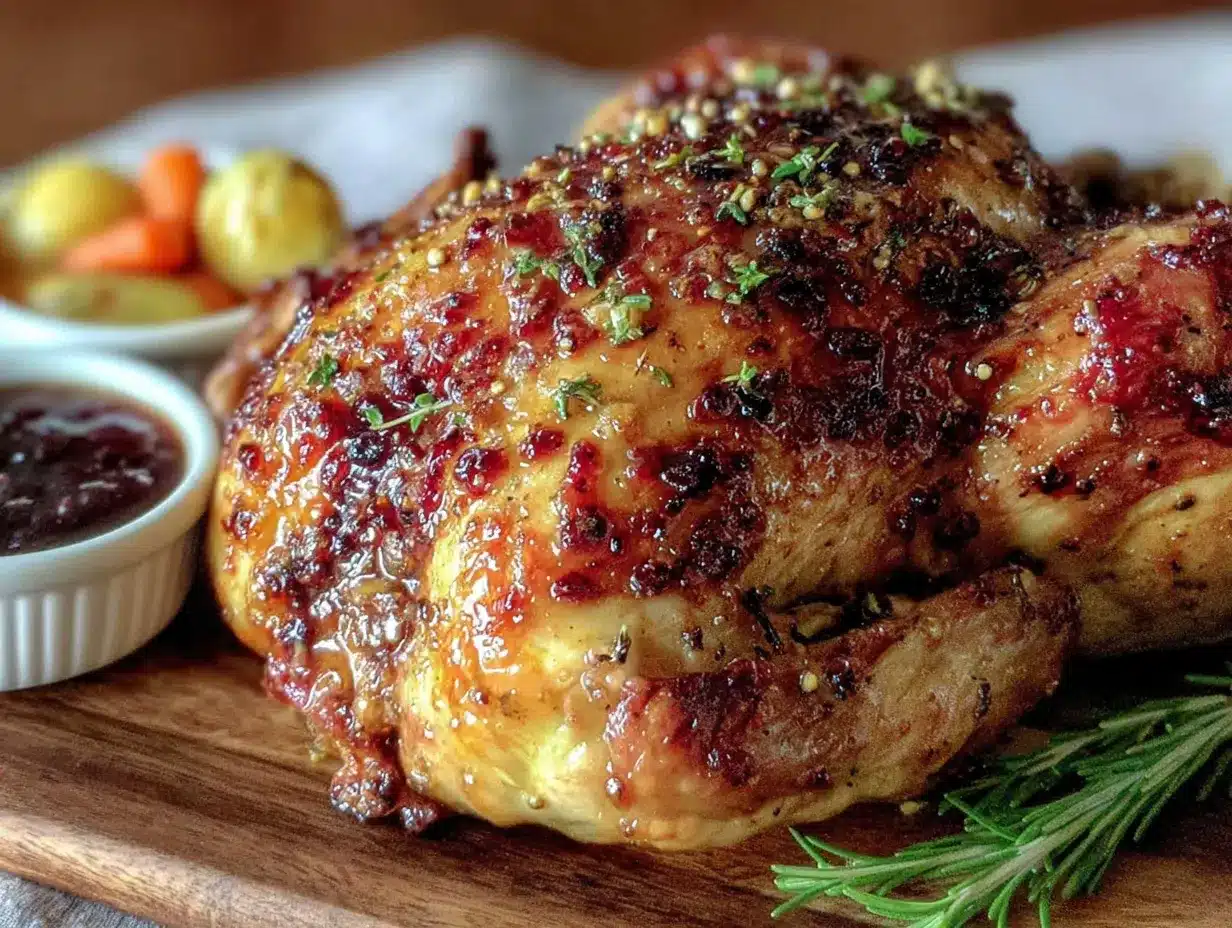
- 1 whole turkey (12-14 pounds), completely thawed if frozen (adds richness and helps the skin get crispy)
- 1 large onion, quartered (for stuffing the cavity—adds moisture from the inside)
- 1 lemon, halved (a little acidity helps balance the richness)
- 4 sprigs fresh rosemary (for the cavity and for garnish)
- 4 sprigs fresh thyme (same—toss them in the cavity)
- 2 cups low-sodium chicken broth (for the bottom of the roasting pan—keeps the drippings from burning)
- 2 tablespoons olive oil (for rubbing the outside of the turkey before seasoning)
- Additional salt and pepper for seasoning the outside
A few ingredient notes from my kitchen: If you’re using dried herbs instead of fresh, cut the amount by about two-thirds. Dried herbs are more concentrated, so you’ll need less. For the butter, make sure it’s truly softened—leave it on the counter for at least an hour. Cold butter won’t spread properly under the skin, and that’s where the magic happens. If you’re dairy-free, you can use a high-quality vegan butter, but honestly, the real thing gives the best results here. And please don’t skip the lemon zest in the herb butter. That little bit of citrus cuts through the richness and makes the flavors pop. I learned that the hard way after one Thanksgiving where the turkey was good but somehow… flat. The zest fixes that.
Equipment Needed
You don’t need a professional kitchen to make this perfect herb butter roasted turkey for beginners. Here’s what I use:
- Roasting pan with a rack (the rack keeps the turkey elevated so air circulates and the bottom doesn’t get soggy). No roasting pan? A large rimmed baking sheet with a wire cooling rack works in a pinch—I’ve done it.
- Meat thermometer (this is non-negotiable, friends. An instant-read thermometer takes the guesswork out of roasting. I use a Thermapen, but any reliable brand works)
- Kitchen twine for tying the legs together (helps the turkey cook evenly)
- Large cutting board for prepping and carving
- Mixing bowl for combining the herb butter
- Small spatula or spoon for spreading the butter under the skin
- Aluminum foil for tenting the turkey if the skin browns too quickly
- Basting brush or spoon (optional, but helpful for spooning pan juices over the turkey)
If you’re on a budget, skip the fancy roasting pan. A disposable aluminum pan from the grocery store works fine—just double it up so it doesn’t buckle under the weight. And if you don’t have kitchen twine, you can use unflavored dental floss in a pinch. I’ve done that more times than I’d like to admit.
Preparation Method
Let’s get into the actual cooking. This method for herb butter roasted turkey for beginners is broken down into simple, manageable steps. Take your time, and don’t rush—you’ve got this.
- Take the turkey out of the fridge 1 hour before roasting. This is important. A cold turkey cooks unevenly, and the breast meat dries out before the thighs are done. Let it sit on the counter (still wrapped) for about an hour to take the chill off. While you wait, make the herb butter.
- Make the herb butter. In a small bowl, combine the softened butter, minced garlic, chopped rosemary, thyme, sage, parsley, salt, pepper, and lemon zest. Mix it all together with a fork until everything is evenly distributed. The mixture should be spreadable but not melted. If your kitchen is warm and the butter gets too soft, pop it in the fridge for 10 minutes.
- Preheat your oven to 325°F (163°C). Position the rack in the lower third of the oven. You want the turkey to sit in the middle of the oven with plenty of space around it for air circulation.
- Remove the turkey from its packaging. Take out the neck and giblets from the cavities (check both ends—there’s usually a bag in the main cavity and sometimes one in the neck cavity). Pat the turkey bone-dry with paper towels, inside and out. This is crucial for crispy skin. I mean really dry it—get in all the nooks and crannies.
- Season the cavity. Sprinkle salt and pepper inside the turkey cavity. Stuff it with the quartered onion, halved lemon, and the extra herb sprigs. Don’t pack it too tight—you want air to circulate.
- Apply the herb butter. This is the secret step. Gently use your fingers to loosen the skin over the turkey breast. Start at the neck end and work your fingers underneath the skin, separating it from the meat without tearing the skin. Be patient—it takes a minute. Once you’ve created a pocket, take about two-thirds of the herb butter and spread it directly onto the breast meat under the skin. Use your fingers to massage it around so it covers both breasts evenly. Then rub the remaining butter all over the outside of the turkey—the legs, the thighs, the wings, everything. Don’t forget the underside.
- Tie the legs together with kitchen twine. Cross the legs and wrap the twine around them, then tie a knot. This helps the turkey cook evenly and gives it that classic shape. Tuck the wing tips under the turkey so they don’t burn.
- Place the turkey on the roasting rack in your pan. Pour the chicken broth into the bottom of the pan—not over the turkey. The broth will create steam and keep the drippings from burning, which means better gravy later.
- Roast the turkey for about 13-15 minutes per pound. For a 12-14 pound turkey, that’s roughly 2.5 to 3.5 hours. Start checking the temperature after 2 hours. The turkey is done when the thickest part of the thigh reaches 165°F (74°C) and the breast reaches 160°F (71°C). Insert your thermometer into the inner thigh near the breast, being careful not to hit bone.
- Baste once or twice if you want, but honestly? You don’t need to. The herb butter keeps everything moist. If the skin is browning too fast (around the 2-hour mark), tent the turkey loosely with aluminum foil.
- Let the turkey rest for at least 30 minutes before carving. This is the hardest part—I know you’ll want to dig in. But resting allows the juices to redistribute throughout the meat. If you cut into it too soon, all those lovely juices will run out onto the cutting board, and you’ll have dry turkey. Cover it loosely with foil and let it sit. Use this time to make gravy from the pan drippings.
A few sensory cues to watch for: The turkey should be a deep golden brown when it’s done. The skin will look tight and shiny. You’ll smell the herbs and garlic filling your kitchen—that’s the best part. And when you insert the thermometer, the juices should run clear, not pink.
Cooking Tips & Techniques
After making this herb butter roasted turkey for beginners more times than I can count, I’ve picked up a few tricks that make a real difference. Here’s what I wish someone had told me the first time:
Don’t skip the drying step. I know it seems fussy, but patting the turkey dry is the single most important thing you can do for crispy skin. Moisture is the enemy of browning. I once skipped this step because I was in a hurry, and the skin came out pale and rubbery. Learn from my mistake.
Use a thermometer, not the pop-up timer. Those little plastic pop-up things that come with the turkey are notoriously unreliable. They’re designed to pop at around 180°F, which is way overcooked for breast meat. Trust your instant-read thermometer instead. Pull the turkey when the thigh hits 165°F and the breast hits 160°F. Carryover cooking will bring the breast up to 165°F while it rests.
Let the butter soften properly. Cold butter won’t spread under the skin—it’ll just tear the skin and make a mess. Leave it out for at least an hour before you start. If you forget, you can microwave it in 5-second bursts, but be careful not to melt it. You want it soft, not liquid.
Multitask strategically. While the turkey roasts, prep your side dishes. The oven is occupied, but your stovetop is free. Make your mashed potatoes, green beans, or stuffing while the turkey does its thing. When the turkey comes out to rest, you can pop any casseroles or rolls into the oven to warm up.
Make gravy while the turkey rests. Those pan drippings are liquid gold. After you remove the turkey to rest, place the roasting pan on the stovetop over medium heat. Whisk in a few tablespoons of flour, cook for a minute, then slowly add chicken broth while whisking constantly. Season with salt and pepper, and you’ve got the most incredible gravy.
Variations & Adaptations
One of the best things about this herb butter roasted turkey for beginners is how adaptable it is. Here are some variations I’ve tried and loved:
Citrus-Herb Turkey: Add the zest of one orange and one lemon to the herb butter, and stuff the cavity with orange and lemon halves instead of just lemon. The citrus adds a bright, fresh note that’s especially nice if you’re serving the turkey with fruity sides like cranberry sauce.
Spicy Herb Turkey: Add 1 teaspoon of red pepper flakes or ½ teaspoon of cayenne pepper to the herb butter. It doesn’t make the turkey spicy per se—it just adds a warm, subtle heat that’s really interesting. My brother-in-law requests this version every year.
Dairy-Free Version: Use vegan butter or high-quality olive oil instead of butter. The texture won’t be exactly the same (the skin might not get quite as crispy), but the flavor will still be fantastic. Just make sure to rub the oil both under and over the skin.
Herb Variations: Don’t have fresh rosemary or sage? No problem. Use what you’ve got. Tarragon is lovely with turkey, as is marjoram. Dill works in a pinch. The ratios stay the same—just swap in whatever fresh herbs look good at the store.
Spatchcock Method: If you want a faster-cooking, extra-crispy turkey, try spatchcocking it. Use kitchen shears to cut out the backbone, then flatten the turkey before applying the herb butter. It cooks in about 1.5 hours at 425°F. I do this sometimes when I’m short on oven time, and honestly, the skin comes out even crispier.
Serving & Storage Suggestions
This herb butter roasted turkey for beginners deserves to be shown off. Here’s how I serve and store mine:
Serving: Transfer the rested turkey to a large platter. Arrange fresh herb sprigs and lemon wedges around it for a beautiful presentation. Carve at the table if you’re feeling fancy, or slice it in the kitchen and arrange the meat on a warm platter. Serve with the pan gravy on the side. The turkey is best served warm, but it’s also delicious at room temperature—perfect for buffet-style gatherings.
What to serve with it: Classic mashed potatoes, green bean casserole, roasted Brussels sprouts, cranberry sauce, dinner rolls, and stuffing are all perfect companions. The herb flavors in the turkey play beautifully with sage stuffing and buttery mashed potatoes.
Storage: Remove all the meat from the bones within 2 hours of cooking. Store the meat in an airtight container in the refrigerator for up to 4 days. The bones and carcass? Don’t throw them away! Use them to make turkey stock—just cover them with water, add some onion, carrot, celery, and herbs, and simmer for a few hours. Freeze the stock for soups and stews later.
Reheating: The best way to reheat leftover turkey is gently. Place slices in a baking dish, add a splash of chicken broth, cover with foil, and warm in a 300°F oven for about 15 minutes. This keeps the meat from drying out. Avoid the microwave if you can—it tends to make the meat tough and rubbery.
Flavor development: Honestly, leftover turkey often tastes even better the next day. The herbs have more time to meld, and the meat becomes incredibly tender. I love making turkey sandwiches with leftover herb butter turkey—a little mayo, some cranberry sauce, and a pile of turkey on good bread. Perfection.
Nutritional Information & Benefits
Here’s the nutritional breakdown for a 4-ounce serving of this herb butter roasted turkey for beginners (skin-on, with herb butter):
| Nutrient | Amount |
|---|---|
| Calories | 250 |
| Protein | 30g |
| Fat | 14g |
| Saturated Fat | 7g |
| Carbohydrates | 1g |
| Fiber | 0g |
| Sodium | 350mg |
Turkey is an excellent source of lean protein, which is great for muscle health and keeping you full. It’s also rich in B vitamins, particularly B6 and B12, which support energy metabolism and brain function. The herbs in the butter—rosemary, thyme, sage, and parsley—are packed with antioxidants and anti-inflammatory compounds. Plus, garlic is known for its immune-boosting properties. So yes, this indulgent holiday meal actually has some health benefits hiding in there.
If you’re watching your sodium, reduce the salt in the herb butter and skip the extra salt on the outside of the turkey. The herbs provide plenty of flavor on their own. This recipe is naturally gluten-free and low-carb, making it a good option for various dietary needs. Just be sure to check your chicken broth if you’re gluten-sensitive—some brands contain wheat-based additives.
Conclusion
This perfect herb butter roasted turkey for beginners is the recipe that saved my Thanksgiving—and it can save yours too. It’s simple enough for someone who’s never roasted a turkey before, yet impressive enough to fool your guests into thinking you spent all day in the kitchen. The herb butter does all the work: it keeps the meat moist, infuses every bite with flavor, and creates that gorgeous golden-brown skin we all dream about.
I love this recipe because it reminds me that cooking doesn’t have to be complicated to be amazing. Sometimes the best dishes come from a place of panic and a handful of simple ingredients. That turkey I made with Carol’s napkin recipe? It’s now the only turkey I’ll ever make. It’s become a tradition, and every time I pull that golden bird out of the oven, I smile thinking about how close I came to ordering pizza.
Now I want to hear from you. What’s your favorite way to season a turkey? Have you tried this herb butter method? Drop a comment below and let me know—I read every single one. And if you make this recipe, tag me in your photos. I love seeing your beautiful turkeys. Happy roasting, friends!
Frequently Asked Questions
Can I use dried herbs instead of fresh?
Yes, you can. Use about one-third of the amount called for in the recipe, since dried herbs are more concentrated. So if the recipe calls for 2 tablespoons of fresh rosemary, use about 2 teaspoons of dried. The flavor won’t be quite as bright, but it’ll still be delicious.
How do I know when the turkey is fully cooked?
The most reliable way is with a meat thermometer. Insert it into the thickest part of the thigh without touching bone. The turkey is done when the thigh reaches 165°F and the breast reaches 160°F. The breast temperature will rise to 165°F while the turkey rests.
Do I need to baste the turkey?
Nope! That’s the beauty of this recipe. The herb butter keeps the meat moist without any basting. If you want to baste for tradition’s sake, go ahead once or twice, but it’s not necessary. Opening the oven door too often actually slows down the cooking process.
Can I stuff the turkey with stuffing?
You can, but I don’t recommend it. Stuffing cooked inside the turkey needs to reach 165°F to be safe, which often means overcooking the bird. Instead, make your stuffing separately in a baking dish. It’s safer, easier, and honestly tastes just as good.
How far ahead can I make the herb butter?
You can make the herb butter up to 3 days in advance. Store it tightly wrapped in the refrigerator, and let it come to room temperature for about 30 minutes before using. You can also freeze the herb butter for up to 3 months—just thaw it in the fridge overnight before you need it.
Pin This Recipe!
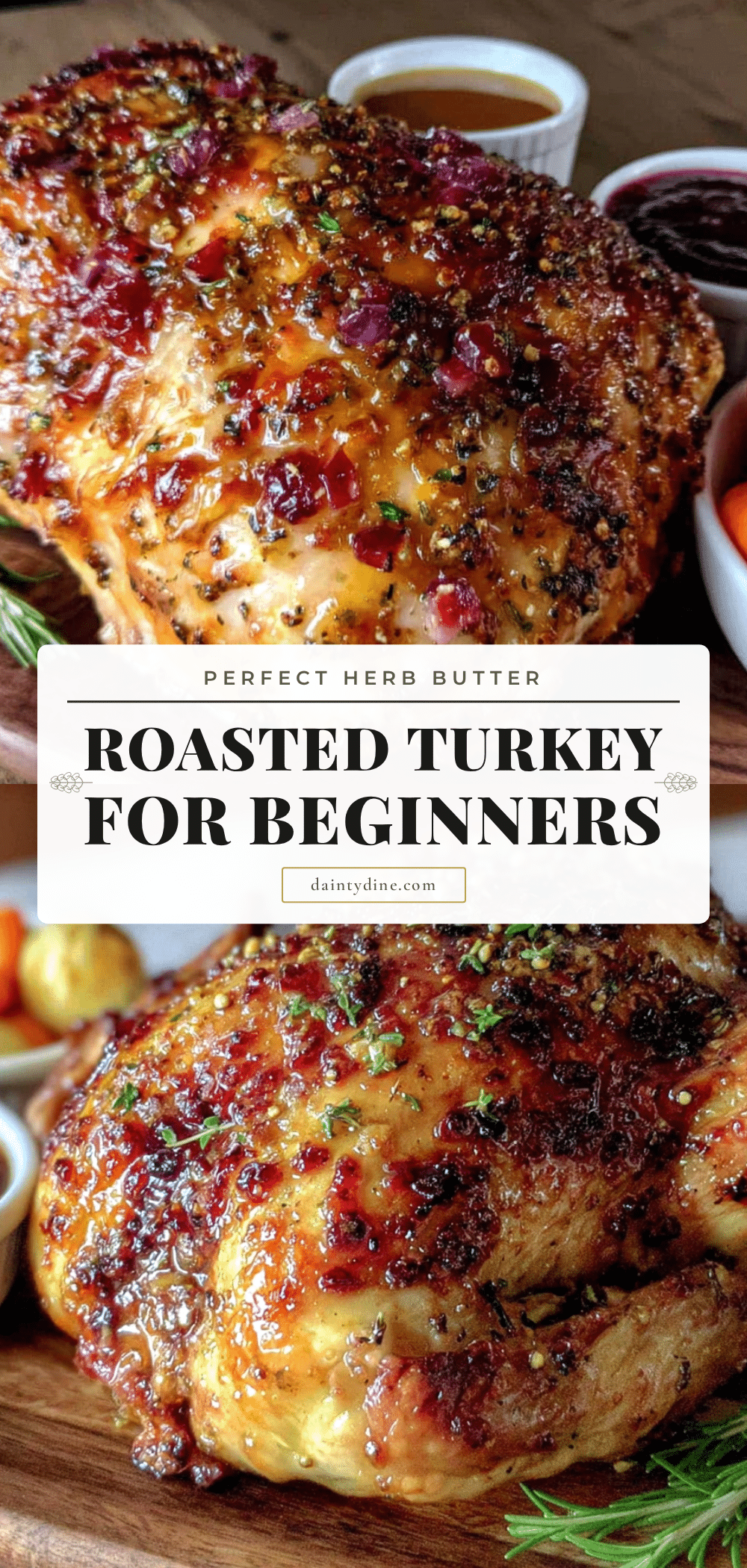
Easy Herb Butter Roasted Turkey for Beginners
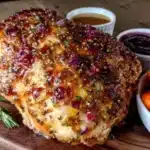
This foolproof herb butter roasted turkey delivers a golden, juicy bird without brining or complicated techniques. Perfect for beginners, it uses simple ingredients and minimal prep for an impressive holiday centerpiece.
- Prep Time: 15 minutes
- Cook Time: 3 hours
- Total Time: 3 hours 45 minutes
- Yield: 12 servings 1x
- Category: Main Course
- Cuisine: American
Ingredients
- 1 cup (2 sticks) unsalted butter, softened
- 4 cloves garlic, minced
- 2 tablespoons fresh rosemary, finely chopped
- 2 tablespoons fresh thyme leaves, chopped
- 2 tablespoons fresh sage, finely chopped
- 1 tablespoon fresh parsley, chopped
- 1 teaspoon salt
- ½ teaspoon black pepper, freshly ground
- 1 teaspoon lemon zest (optional)
- 1 whole turkey (12–14 pounds), thawed
- 1 large onion, quartered
- 1 lemon, halved
- 4 sprigs fresh rosemary
- 4 sprigs fresh thyme
- 2 cups low-sodium chicken broth
- 2 tablespoons olive oil
- Additional salt and pepper for seasoning
Instructions
- Take the turkey out of the fridge 1 hour before roasting to bring to room temperature.
- Make the herb butter: In a small bowl, combine softened butter, minced garlic, chopped rosemary, thyme, sage, parsley, salt, pepper, and lemon zest. Mix until evenly distributed.
- Preheat oven to 325°F (163°C). Position rack in lower third of oven.
- Remove turkey from packaging. Remove neck and giblets from cavities. Pat turkey bone-dry with paper towels, inside and out.
- Season the cavity with salt and pepper. Stuff with quartered onion, halved lemon, and extra herb sprigs.
- Gently loosen the skin over the turkey breast with your fingers. Spread about two-thirds of the herb butter directly onto the breast meat under the skin. Rub remaining butter all over the outside of the turkey.
- Tie the legs together with kitchen twine. Tuck wing tips under the turkey.
- Place turkey on roasting rack in pan. Pour chicken broth into bottom of pan (not over turkey).
- Roast for about 13-15 minutes per pound (2.5 to 3.5 hours for 12-14 lb turkey). Start checking temperature after 2 hours. Turkey is done when thickest part of thigh reaches 165°F and breast reaches 160°F.
- Baste once or twice if desired (not necessary). If skin browns too fast, tent loosely with foil.
- Let turkey rest for at least 30 minutes before carving.
Notes
Patting the turkey dry is crucial for crispy skin. Use a meat thermometer for accuracy. Let butter soften properly for easy spreading. Make gravy from pan drippings while turkey rests.
Nutrition
- Serving Size: 4 ounces
- Calories: 250
- Sodium: 350
- Fat: 14
- Saturated Fat: 7
- Carbohydrates: 1
- Protein: 30
Keywords: herb butter turkey, roasted turkey, Thanksgiving turkey, beginner turkey recipe, easy turkey