Love this? Save it for later!
Share the inspiration with your friends
Marta, the woman who runs the little corner market near my apartment, watched me one afternoon as I stood staring at a bag of bread flour like it held the secrets to the universe. I was frustrated, honestly—my sourdough starter was healthy and bubbly, but my loaves kept coming out flat and dense. She didn’t say anything at first. She just finished weighing someone’s tomatoes, wiped her hands on her apron, and walked over. “You’re overthinking it,” she said, not unkindly. “Come see me tomorrow morning. I’ll show you something easier.”
The next day, I showed up before the store even opened, and there she was, a bowl of sticky, fragrant dough already bubbling away on the counter behind the register. She didn’t give me a written recipe or a lecture. She just talked while she worked—about the focaccia her grandmother made in a wood-fired oven in a small town near Bari, about how the best bread doesn’t come from perfect technique but from patience and a light hand. She showed me how to dimple the dough with my fingertips, how to let the olive oil pool in those little wells, and how to be generous with the salt. “Salt is not the enemy,” she said, laughing. “Bland bread is the enemy.”
I went home and made my first real focaccia that same afternoon. It wasn’t perfect—I got distracted and let it over-proof by about an hour, and the top got a little too dark in one corner. But when I pulled it from the oven, golden and crackling, and the smell of olive oil and rosemary filled my whole apartment? Let me tell you, I actually teared up a little. It was the first time my sourdough starter and I had truly made something beautiful together. This cozy sourdough focaccia with rosemary and sea salt isn’t just a recipe—it’s the bread that taught me to stop fighting my dough and start listening to it. And maybe you’ve been there too, staring at a bag of flour, wondering why something so simple feels so hard. This one changes things.
Why You’ll Love This Recipe
I have made this cozy sourdough focaccia with rosemary and sea salt more times than I can count, and honestly, it still surprises me. Every batch feels a little different, and that’s exactly what makes it so special. Here is why this recipe has earned a permanent spot in my weekly rotation:
- Simple Ingredients : You only need flour, water, olive oil, salt, rosemary, and your sourdough starter. No yeast packets, no fancy additives—just pantry staples.
- Minimal Hands-On Time : The dough does most of the work while you go about your day. Active prep takes about 15 minutes, and the rest is just waiting (the easy part).
- Perfect for Cozy Evenings : There is something deeply soothing about the process of making focaccia on a cold, rainy afternoon. It turns your kitchen into the warmest room in the house.
- Crowd-Pleaser : I have brought this to potlucks, holiday dinners, and casual get-togethers, and it never fails to disappear. People love the crispy edges and soft, airy interior.
- Soul-Satisfying Comfort : That first bite, when the flaky sea salt hits your tongue and the rosemary aroma wraps around you—it is pure, unfiltered comfort food.
What sets this recipe apart from the countless focaccia recipes out there is the sourdough fermentation. The tangy complexity that develops over a long, slow rise cannot be replicated with commercial yeast. It adds a depth of flavor that makes this bread taste like it came from a rustic Italian bakery, not your home oven. Plus, the extended fermentation makes the bread easier to digest—a bonus your gut will thank you for.
This isn’t just another bread recipe. It is the one that makes you close your eyes after the first bite, the one that makes you text a photo to your mom, the one that turns a simple dinner into a memorable meal. It is comfort food reimagined—slower, more intentional, but with the same soul-soothing satisfaction.
What Ingredients You Will Need
This cozy sourdough focaccia with rosemary and sea salt relies on a short list of humble ingredients, but each one plays a crucial role in building flavor and texture. Most of these are probably already in your pantry, which makes this recipe feel almost too easy.
- Bread Flour (500 grams / about 4 cups) : I prefer bread flour here because its higher protein content gives the focaccia that chewy, satisfying crumb. You can use all-purpose flour in a pinch, but the texture will be slightly less structured. I have had great results with King Arthur Bread Flour, but any good brand works.
- Sourdough Starter (200 grams / about 1 cup), active and bubbly : This is the heart of the recipe. Make sure your starter is well-fed and doubled in size before you begin. A hungry, sluggish starter will result in a dense focaccia that doesn’t rise properly. Feed it 4-6 hours before mixing your dough, and look for lots of bubbles on the surface.
- Warm Water (350 grams / about 1 ½ cups) : The water should feel like a warm bath—not hot, not cold. If it is too hot, it can kill the beneficial bacteria in your starter. If it is too cold, fermentation will slow down significantly. I use filtered water to avoid any chlorine that might interfere with the sourdough.
- Extra-Virgin Olive Oil (¼ cup / 60 ml, plus more for the pan and drizzling) : Do not skimp here. A good-quality olive oil adds richness and helps create that crispy, almost fried bottom crust. I love using a robust, peppery oil from California or Greece. You will also need extra for generously coating the baking pan and drizzling over the top before baking.
- Fine Sea Salt (2 teaspoons / 10 grams) : This goes into the dough itself to enhance the overall flavor. Do not skip it—unsalted bread tastes flat and sad.
- Flaky Sea Salt (for finishing) : This is non-negotiable for me. The crunchy, salty crystals on top of the baked focaccia create a beautiful contrast with the soft, oily crumb. Maldon sea salt flakes are my go-to, but any flaky finishing salt will do.
- Fresh Rosemary (2-3 sprigs, leaves stripped and roughly chopped) : Fresh rosemary is miles ahead of dried here. It releases its aromatic oils into the olive oil as the focaccia bakes, infusing every bite with that woodsy, pine-like flavor. If you only have dried, use about 1 tablespoon and crush it slightly between your fingers to release the oils.
Ingredient Selection Tips : For the best texture, look for a bread flour with at least 12% protein content. If you are feeling adventurous, you can substitute up to 20% of the bread flour with whole wheat or spelt flour for a nuttier flavor—just note that the crumb will be slightly denser. And if you are dairy-free or vegan, congratulations—this recipe is already naturally both!
Equipment Needed
You do not need a fancy kitchen to make this cozy sourdough focaccia with rosemary and sea salt. Here is what you will need:
- A Large Mixing Bowl : Go for something big enough to allow the dough to expand. I use a wide ceramic bowl that gives me plenty of room to mix without flour flying everywhere.
- A Bench Scraper or Flexible Dough Scraper : This little tool is a lifesaver for handling sticky sourdough. It helps you fold the dough without getting your hands completely covered.
- A 9×13-inch Baking Pan : A metal or dark-colored pan works best for getting that crispy bottom crust. Glass or ceramic pans work too, but they may need an extra 5-10 minutes in the oven.
- Plastic Wrap or a Shower Cap : To cover the dough during its long rise. A reusable shower cap is actually perfect for this—it fits snugly over the bowl and is easy to wash.
- Kitchen Scale : I cannot recommend this enough. Baking with a scale is more accurate and consistent than measuring by volume, especially with sourdough where hydration ratios matter.
- Oven Thermometer : Ovens lie about their temperature all the time. An inexpensive oven thermometer ensures your oven is actually at 425°F when you think it is.
Budget-Friendly Options : If you do not have a bench scraper, a stiff metal spatula works in a pinch. No kitchen scale? Use the spoon-and-level method for measuring flour, but be aware that results will vary. Honestly, I made this recipe for months with just a bowl, a wooden spoon, and a baking dish—it is forgiving enough to work with whatever you have.
Preparation Method
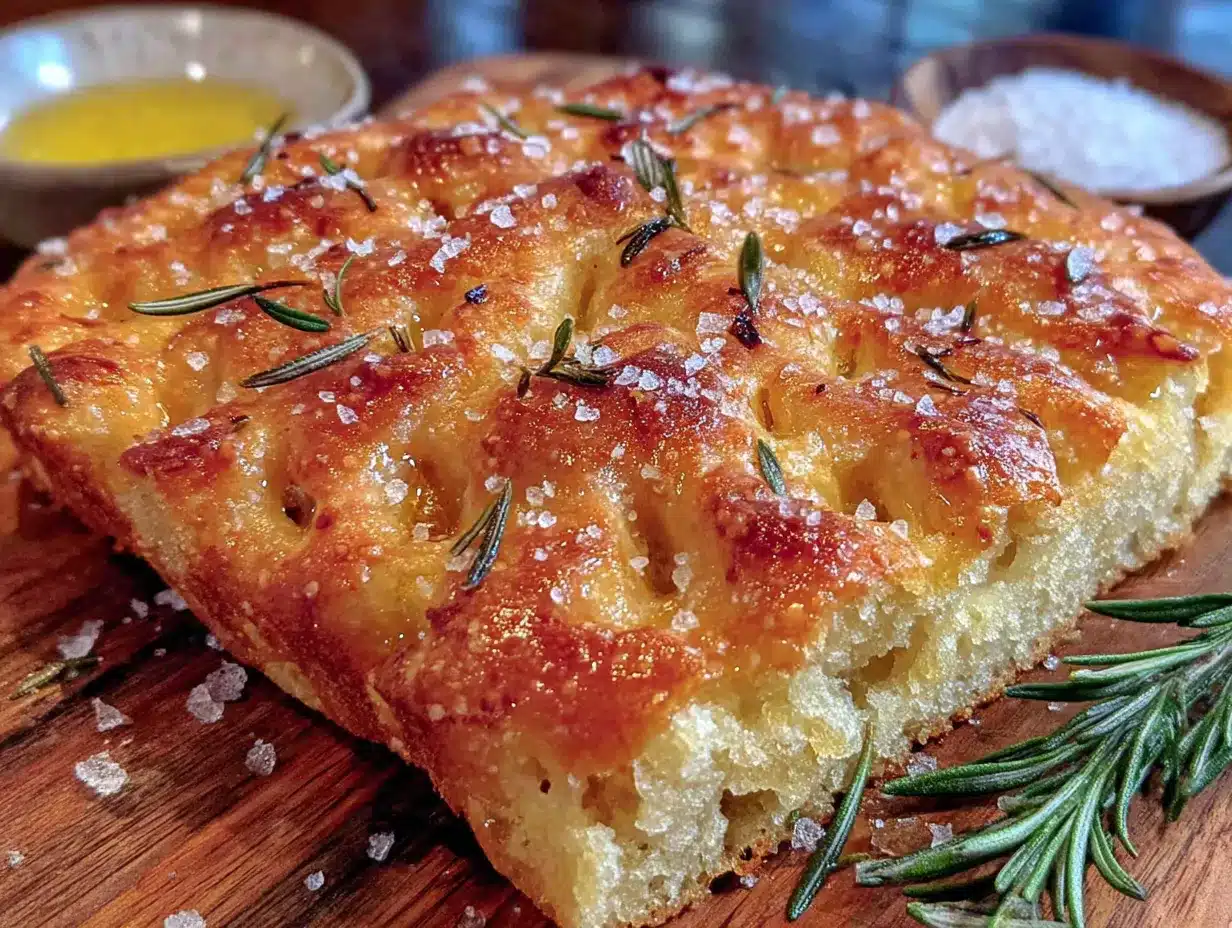
Making this cozy sourdough focaccia with rosemary and sea salt is a slow, meditative process. The timeline stretches across a day, but the active work is minimal. Here is how to do it:
- Feed Your Starter (Morning, Day 1) : About 4-6 hours before you plan to mix the dough, feed your sourdough starter. You need 200 grams of active, bubbly starter. I usually feed it a 1:1:1 ratio (100g starter, 100g flour, 100g water) and let it sit at room temperature until it doubles in size and the surface is covered in bubbles.
- Mix the Dough (Late Morning, Day 1) : In a large bowl, combine 500 grams of bread flour and 2 teaspoons of fine sea salt. Whisk them together. Make a well in the center and add 200 grams of active sourdough starter, 350 grams of warm water, and 2 tablespoons of olive oil. Stir everything together with a wooden spoon or your hand until a shaggy, sticky dough forms. It will look rough and lumpy—that is completely normal.
- Perform Stretch and Folds (Every 30 Minutes, 4 Times) : This is the secret to building strength in a wet, high-hydration dough without kneading. Wet your hands slightly to prevent sticking. Grab one side of the dough, stretch it up, and fold it over the center. Rotate the bowl 90 degrees and repeat. Do this 4 times total (one full rotation). Cover the bowl and rest for 30 minutes. Repeat this stretch-and-fold process 3 more times, for a total of 4 rounds over 2 hours. After the final fold, the dough should feel smoother and more elastic.
- Bulk Fermentation (Afternoon to Evening, Day 1) : Cover the bowl tightly with plastic wrap or a reusable cover. Let it rest at room temperature (ideally 70-75°F) for 8-12 hours. The dough should double in size, become bubbly on the surface, and smell pleasantly sour and yeasty. If your kitchen is cold, it may take closer to 12 hours. Do not rush this step—patience is rewarded.
- Prepare the Pan and Shape (Next Morning, Day 2) : Generously coat your 9×13-inch baking pan with olive oil—do not be shy here. Pour the dough into the pan. It will be loose and sticky. Using oiled hands, gently coax the dough to the edges of the pan. If it resists, let it rest for 15 minutes and try again. Do not tear the dough. Cover the pan loosely with plastic wrap and let it rest for 1 hour.
- Dimple and Top (1 Hour Later) : After the rest, the dough should have relaxed and spread out. Drizzle another 2 tablespoons of olive oil over the top. Now for the fun part—using your fingertips, press deep dimples all over the surface of the dough. Do not be gentle here; you want those little wells to hold the oil and salt. Sprinkle the chopped fresh rosemary evenly over the top, followed by a generous pinch of flaky sea salt.
- Preheat the Oven : Place your oven rack in the middle position and preheat to 425°F (220°C). If you have a baking stone or steel, place it on the rack below to help create a crisp bottom crust.
- Bake (25-30 Minutes) : Place the pan in the preheated oven and bake for 25-30 minutes, rotating the pan halfway through. The focaccia is done when the top is deep golden brown, the edges are crispy and slightly darker, and the bottom sounds hollow when tapped. If the top is browning too quickly but the center is still pale, tent loosely with foil for the last 5 minutes.
- Cool and Serve : Remove the pan from the oven and let the focaccia cool in the pan for 5 minutes. Then transfer it to a wire rack. Do not skip this step—cooling on a rack prevents the bottom from getting soggy. Let it cool for at least 15 minutes before cutting. I know it is tempting to tear into it immediately, but the texture improves as it settles.
Sensory Cue : When you press your fingertip into the proofed dough, it should spring back slowly, leaving a slight indentation. If it springs back instantly, it needs more time. If it does not spring back at all, it may be over-proofed.
Cooking Tips & Techniques
After making this cozy sourdough focaccia with rosemary and sea salt more times than I can count, I have collected a few hard-won lessons. Here are the tips that make the biggest difference:
Use a Wet Hand for Sticky Dough : Sourdough focaccia dough is wet—really wet. Instead of adding more flour (which makes the bread dense), simply wet your hands with cool water before handling the dough. This prevents sticking without altering the hydration ratio. It feels weird the first time, but it works like magic.
Do Not Skip the Stretch and Folds : I tried skipping this step once when I was short on time, and the result was a flat, dense focaccia with very little oven spring. Those four rounds of stretching and folding build the gluten network that traps gas bubbles and gives you that light, airy crumb. It is only 2 minutes of work every half hour—set a timer and do it.
Watch Your Water Temperature : In winter, my kitchen drops to around 65°F, and my dough takes forever to rise. I now use slightly warmer water (about 85°F) during cold months to give the fermentation a head start. In summer, I use cooler water (around 70°F) to prevent the dough from over-proofing too quickly. Pay attention to your environment and adjust accordingly.
Dimple with Confidence : The first time I made focaccia, I was too timid with my dimpling. I barely pressed into the dough, and the oil just sat on top. Now I press all the way down until my fingertips hit the pan. Those deep wells create pools of olive oil that crisp up beautifully in the oven and create those irresistible crunchy spots.
Let It Cool—Really : I know the smell of freshly baked focaccia is almost impossible to resist. But cutting into it while it is still hot will result in a gummy, doughy interior. The starches need time to set. I have burned my tongue more than once in my impatience. Give it at least 15-20 minutes. Trust me, it is worth the wait.
My Biggest Failure : I once left my dough to bulk ferment for 14 hours on a hot summer day. It rose beautifully, but by the time I shaped it, the gluten had completely broken down, and the dough turned into a sticky, lifeless puddle. It baked into a flat, sour-tasting disc. That was the day I learned that over-proofing is a real thing. If your dough smells strongly of vinegar or acetone, you have gone too far.
Variations & Adaptations
This cozy sourdough focaccia with rosemary and sea salt is a wonderful blank canvas. Here are some variations I have tried and loved:
- Garlic and Herb Focaccia : Before dimpling, press 3-4 thinly sliced garlic cloves into the dough. Add fresh thyme and oregano along with the rosemary. The garlic roasts into sweet, mellow pockets of flavor.
- Everything Bagel Focaccia : After dimpling and oiling, sprinkle generously with everything bagel seasoning (sesame seeds, poppy seeds, dried garlic, dried onion, and salt). This version disappears fastest at brunch.
- Caramelized Onion and Feta Focaccia : While the dough is doing its final proof, slowly caramelize 2 large sliced onions in olive oil for about 30 minutes. Dot them over the dimpled dough along with crumbled feta cheese before baking. The salty, sweet combination is unforgettable.
- Gluten-Free Version : Substitute the bread flour with a high-quality gluten-free all-purpose blend that contains xanthan gum. The dough will be more like a thick batter, and you will need to bake it for an additional 5-10 minutes. The texture is different—more cakey than chewy—but still delicious.
- Whole Wheat Variation : Replace 100 grams of the bread flour with whole wheat flour. The dough will absorb slightly more water, so add an extra tablespoon of water if it feels too stiff. The flavor becomes nuttier and more rustic.
My Personal Favorite : I once added a handful of pitted Kalamata olives and a sprinkle of red pepper flakes to the top before baking. The briny olives paired beautifully with the rosemary, and the red pepper gave it a subtle warmth that was perfect with a bowl of tomato soup on a cold night.
Serving & Storage Suggestions
This cozy sourdough focaccia with rosemary and sea salt is incredibly versatile. Here is how to serve and store it:
Serving : Serve warm or at room temperature. It is wonderful on its own as a snack, but it truly shines as a side dish. Pair it with a hearty bowl of minestrone soup, a simple green salad with lemon vinaigrette, or a plate of roasted vegetables. It also makes the best sandwich bread—split a piece horizontally and fill it with prosciutto, fresh mozzarella, and arugula.
Storage : Store leftover focaccia in an airtight container at room temperature for up to 2 days. Do not refrigerate it—the cold air will dry it out and make the crumb stale. If you need to keep it longer, wrap it tightly in plastic wrap and then foil, and freeze for up to 3 months.
Reheating : The best way to revive focaccia is to reheat it in a 350°F oven for 5-8 minutes. This restores the crispy crust and soft interior. If you are in a hurry, you can microwave it for 15 seconds, but the texture will be softer and less crispy. For a quick fix, I sometimes toast slices in a dry skillet over medium heat for a minute per side.
Flavor Development : Honestly, this focaccia tastes even better the next day. The flavors of the rosemary and olive oil meld together overnight, and the crust softens slightly while remaining chewy. If you can resist eating it all on day one, you are in for a treat on day two.
Nutritional Information & Benefits
This cozy sourdough focaccia with rosemary and sea salt is a wholesome treat. Here is a rough estimate per serving (based on 12 servings):
- Calories : Approximately 220-250 per serving
- Carbohydrates : 38g
- Protein : 6g
- Fat : 6g (mostly from heart-healthy olive oil)
- Fiber : 1.5g
- Sodium : 350mg (varies based on finishing salt)
Health Benefits : The sourdough fermentation process breaks down phytic acid, making the minerals in the flour more bioavailable and easier to digest. Many people who struggle with conventional bread find sourdough easier on their stomach. Olive oil is rich in monounsaturated fats and antioxidants, while rosemary contains compounds with anti-inflammatory properties.
Dietary Considerations : This recipe is naturally vegan and dairy-free. It is not gluten-free unless you use the gluten-free variation mentioned above. The sodium content can be adjusted by reducing the finishing salt.
My Wellness Perspective : I believe food should nourish both body and soul. This focaccia is not about deprivation—it is about slowing down, enjoying the process, and sharing something beautiful with the people you love. A slice of warm bread with good olive oil is one of life’s simplest, most profound pleasures.
Conclusion
This cozy sourdough focaccia with rosemary and sea salt has become a staple in my kitchen for good reason. It is forgiving, deeply flavorful, and requires almost nothing from you except a little patience and a willingness to get your hands messy. The process itself is a form of therapy—mixing the dough, watching it bubble and rise, pulling that golden pan from the oven.
I hope you give this recipe a try, and I hope you make it your own. Add your favorite herbs, throw in some olives, or keep it simple with just rosemary and salt. There is no wrong way to do this. And when you take that first bite, warm and salty and fragrant, I think you will understand why I keep coming back to it week after week.
If you make this, I would love to hear about it. Leave a comment below and tell me how it turned out, or share your own twist on the recipe. Tag me in your photos on social media—I love seeing your beautiful bread! And if you enjoyed this post, please share it with a friend who needs a little cozy comfort in their life.
Happy baking, friends. Your kitchen is about to smell amazing.
Frequently Asked Questions
Can I use active dry yeast instead of sourdough starter?
This recipe is specifically designed for sourdough starter, but you can adapt it. Use 1 teaspoon of active dry yeast dissolved in the warm water, and reduce the water by 50 grams to account for the missing starter hydration. The flavor will be less tangy and complex, but it will still be a delicious focaccia.
Why is my focaccia dough so sticky?
Sourdough focaccia is intentionally a high-hydration dough, which means it is naturally very sticky. Do not be tempted to add more flour. Use wet hands or a wet bench scraper to handle it, and trust the stretch-and-fold process to build strength. The stickiness is what gives you that light, airy crumb.
How do I know when my sourdough starter is ready to use?
Your starter is ready when it has at least doubled in size, the surface is covered in bubbles (both large and small), and it smells pleasantly sour and fruity. It should pass the “float test”—a small spoonful dropped into a glass of water should float on the surface. If it sinks, give it more time.
Can I refrigerate the dough overnight?
Absolutely. After the bulk fermentation, you can cover the bowl tightly and place it in the refrigerator for up to 24 hours. The cold slows down fermentation and develops even more flavor. The next day, let the dough come to room temperature for about an hour before proceeding with shaping and baking.
Why did my focaccia not rise well?
Several factors could be at play. Your starter may not have been active enough—make sure it is bubbly and doubled before mixing. Your kitchen may have been too cold, slowing down fermentation. Or you may have over-proofed the dough, causing the gluten structure to collapse. Try using warmer water and keeping the dough in a warm spot (like near a sunny window or on top of the refrigerator) during bulk fermentation.
Pin This Recipe!

Cozy Sourdough Focaccia with Rosemary and Sea Salt

This forgiving, deeply flavorful sourdough focaccia with rosemary and sea salt requires minimal hands-on time and delivers a crispy, golden crust with a soft, airy interior. Perfect for cozy evenings and crowd-pleasing gatherings.
- Prep Time: 15 minutes
- Cook Time: 30 minutes
- Total Time: 24 hours (including fermentation)
- Yield: 12 servings 1x
- Category: Bread
- Cuisine: Italian
Ingredients
- 500 grams (about 4 cups) bread flour
- 200 grams (about 1 cup) active, bubbly sourdough starter
- 350 grams (about 1 ½ cups) warm water
- ¼ cup (60 ml) extra-virgin olive oil, plus more for the pan and drizzling
- 2 teaspoons (10 grams) fine sea salt
- Flaky sea salt (for finishing)
- 2–3 sprigs fresh rosemary, leaves stripped and roughly chopped
Instructions
- Feed your starter 4-6 hours before mixing the dough. You need 200 grams of active, bubbly starter.
- In a large bowl, whisk together 500 grams bread flour and 2 teaspoons fine sea salt. Make a well and add 200 grams starter, 350 grams warm water, and 2 tablespoons olive oil. Stir until a shaggy, sticky dough forms.
- Perform stretch and folds: Wet your hands, grab one side of the dough, stretch it up, and fold it over the center. Rotate the bowl 90 degrees and repeat. Do 4 stretches (one full rotation). Cover and rest 30 minutes. Repeat this process 3 more times (total of 4 rounds over 2 hours).
- Cover the bowl tightly and let it bulk ferment at room temperature (70-75°F) for 8-12 hours until doubled in size and bubbly.
- Generously coat a 9×13-inch baking pan with olive oil. Pour the dough into the pan. Using oiled hands, gently coax the dough to the edges. If it resists, let it rest 15 minutes and try again. Cover loosely and let rest 1 hour.
- Drizzle another 2 tablespoons olive oil over the dough. Using your fingertips, press deep dimples all over the surface. Sprinkle chopped rosemary and a generous pinch of flaky sea salt on top.
- Preheat oven to 425°F (220°C) with the rack in the middle position.
- Bake for 25-30 minutes, rotating the pan halfway through, until deep golden brown and the bottom sounds hollow when tapped. If browning too quickly, tent with foil for the last 5 minutes.
- Let cool in the pan for 5 minutes, then transfer to a wire rack. Cool at least 15 minutes before cutting.
Notes
Use wet hands to handle sticky dough. Do not skip the stretch and folds. Dimple with confidence—press all the way to the pan. Let cool completely for best texture. Focaccia tastes even better the next day.
Nutrition
- Serving Size: 1 slice (1/12 of rec
- Calories: 235
- Sodium: 350
- Fat: 6
- Saturated Fat: 1
- Carbohydrates: 38
- Fiber: 1.5
- Protein: 6
Keywords: sourdough focaccia, rosemary focaccia, sea salt focaccia, sourdough bread, Italian bread, homemade focaccia, easy focaccia recipe