Love this? Save it for later!
Share the inspiration with your friends
There used to be a tiny, dimly lit cocktail bar on the corner of Elm and 4th in my old neighborhood—a place called The Parlour that specialized in smoked old fashioneds and bar snacks that were anything but ordinary. Every October, they’d go all out for Halloween, and their signature offering was a plate of deviled eggs that looked like they’d been spun by a very stylish spider. When The Parlour closed its doors two years ago—gentrification, honestly—I felt a genuine pang of loss. Not just for the place, but for those eggs. After seven tries—three of which ended up looking like abstract art gone wrong—I finally cracked the code.
I’m not supposed to play favorites with appetizers, but these spider web deviled eggs are the one dish I will absolutely fight for at a potluck. They have that perfect balance of creamy, tangy filling and a dramatic, spooky topping that makes people stop mid-conversation and say, “Wait, how did you do that?” I mean, let’s be real—most Halloween food is either cute but bland, or tasty but totally unthemed. These eggs are the best of both worlds.
You know that feeling when you bring a dish to a party and it disappears before you even get a chance to grab one? That’s these eggs. The first time I made them for a Halloween gathering, my friend Sarah—who claims she “doesn’t even like eggs”—ate three before I could stop staring. The trick is in the texture of the filling and the way the sour cream webbing sets just right. Honestly, if you’ve been searching for that one appetizer that steals the whole show, this is it.
Why You’ll Love This Recipe
Let me tell you why these spider web deviled eggs have become my most-requested Halloween dish. I’ve tested this recipe at four different parties now, and the feedback is always the same—people are genuinely shocked at how easy they are to make, given how incredible they look.
- Visually Stunning : The sour cream web design looks like it took hours of piping skill. Spoiler alert—it takes about two minutes per batch, and I’ll show you exactly how.
- Perfect for Halloween Parties : Whether it’s a costume party, a spooky movie night, or a trunk-or-treat event, these eggs fit right in. They’re the kind of appetizer that makes people pull out their phones for photos before eating.
- Crowd-Pleaser : I’ve served these alongside candy corn and pumpkin cookies, and somehow the deviled eggs always get eaten first. Even picky eaters go back for seconds.
- Make-Ahead Friendly : You can prep the eggs and filling the day before, then add the web design right before serving. This is a lifesaver when you’re hosting a party and have a million other things to do.
- Simple Ingredients : No weird food coloring or specialty baking supplies needed. You probably already have everything in your fridge—eggs, mayo, mustard, sour cream, and black olives.
What makes these spider web deviled eggs different from every other Halloween appetizer I’ve tried is the texture. The filling is extra creamy because I add a tiny splash of pickle juice—trust me on this one. It cuts through the richness and keeps the eggs from tasting heavy. Plus, the sour cream webbing sets up firm enough to hold its shape but stays soft enough to eat without any weird texture contrast. It’s comfort food with a spooky twist, and honestly, it’s the kind of recipe that makes you feel like a kitchen wizard without any of the stress.
What Ingredients You Will Need
This recipe uses simple, everyday ingredients to create something that looks like it came from a professional catering kitchen. The magic is in the technique, not the grocery list.
- 12 large eggs (hard-boiled and peeled—older eggs peel easier, so grab a carton that’s been in your fridge for a week)
- 1/3 cup mayonnaise (I prefer Hellmann’s for its creamy texture, but Duke’s works beautifully if you like a tangier flavor)
- 1 tablespoon yellow mustard (or Dijon if you want a milder, more sophisticated taste)
- 1 teaspoon pickle juice (from a jar of dill pickles—this is my secret ingredient for extra tangy filling)
- 1/4 teaspoon smoked paprika (adds a subtle smokiness and a beautiful color)
- 1/8 teaspoon salt (or to taste—remember the pickle juice adds salt too)
- 1/8 teaspoon black pepper (freshly ground if you have it)
- 1/4 cup sour cream (full-fat works best for the web design—low-fat tends to be too runny)
- 1 can (2.25 ounces) sliced black olives (for the spider bodies—you’ll need about 12 slices)
- Fresh chives or parsley (optional, for garnish—adds a pop of green color)
A few notes on ingredient selection. For the eggs, I really do recommend buying them a week ahead and letting them sit in your fridge. Fresh eggs are a nightmare to peel—the shells stick to the whites and you end up with pockmarked eggs that look sad. For the mayonnaise, I’ve tried homemade versions, and honestly, the store-bought stuff works better here because it’s more stable. The pickle juice is non-negotiable in my book—it’s the difference between a good deviled egg and a great one. If you don’t have pickle juice, you can substitute a splash of white vinegar, but the flavor won’t be quite as complex.
For the spider bodies, look for sliced black olives that are firm and not mushy. I’ve used the canned ones from the grocery store for years and they work perfectly. If you want to get extra fancy, you can buy whole pitted black olives and slice them yourself, but honestly, the pre-sliced ones save time and look just as good.
Equipment Needed
You don’t need any special gadgets for these spider web deviled eggs, which is part of why I love this recipe. Here’s what you’ll need:
- Large pot (for boiling the eggs—make sure it’s big enough that the eggs sit in a single layer)
- Mixing bowl (medium-sized, for the filling)
- Fork or potato masher (for mashing the yolks—I prefer a fork because it gives me more control)
- Piping bag or zip-top bag (for piping the filling into the egg whites—a zip-top bag with the corner snipped off works perfectly)
- Small piping bag or squeeze bottle (for the sour cream web design—a small zip-top bag with a tiny hole works too)
- Toothpick (for creating the web pattern—this is the key tool!)
- Serving platter (a dark-colored platter makes the eggs pop visually)
If you don’t have a piping bag, don’t stress. I’ve made these eggs using a gallon-sized zip-top bag for the filling and a sandwich-sized bag for the sour cream. The key is to not cut too big of a hole—start small and test it on a plate first. For the web design, a toothpick is honestly better than any fancy decorating tool I’ve tried. It gives you that delicate, spiderweb look that’s impossible to achieve with a knife or spatula.
Preparation Method
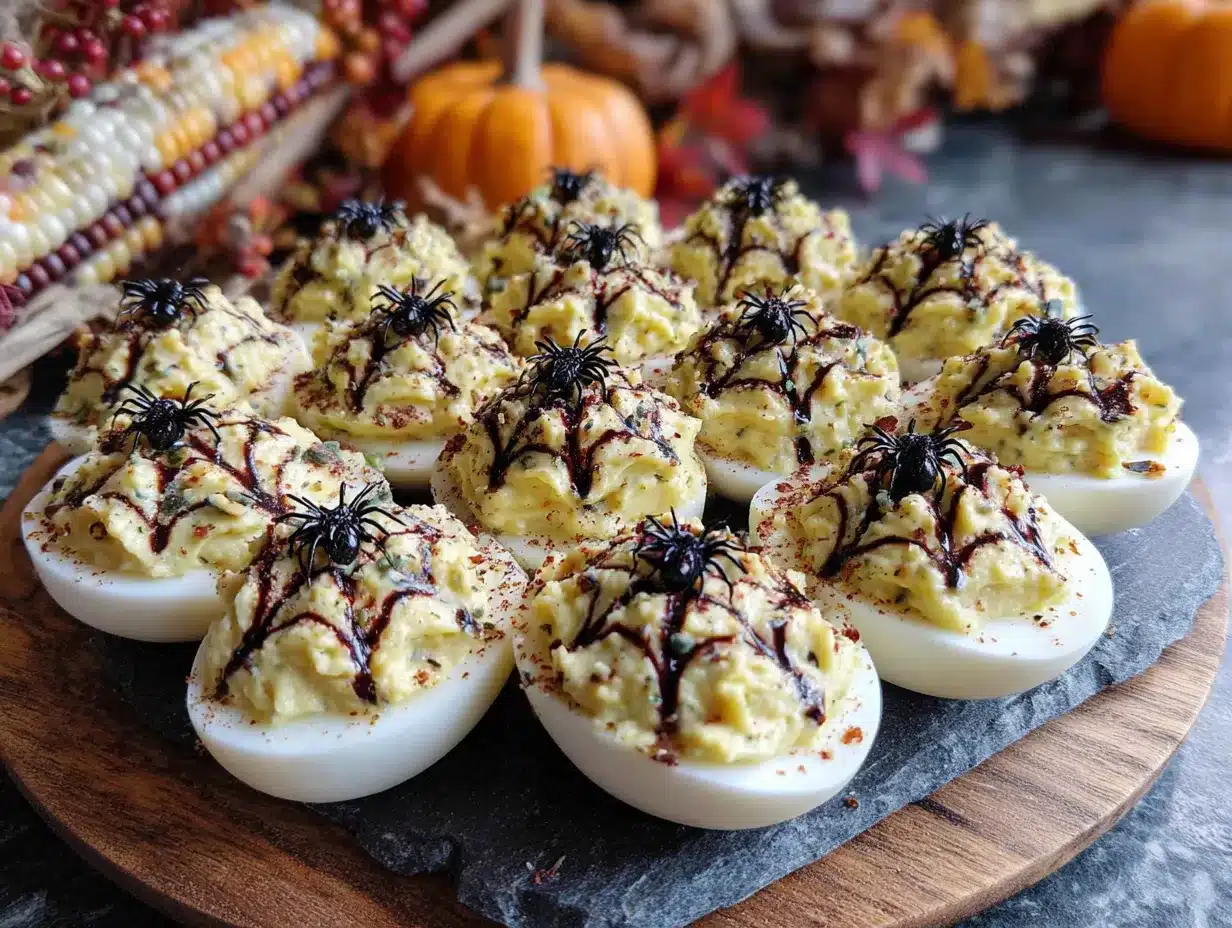
Let me walk you through this step by step. I’ve made these eggs so many times that I’ve got the process down to a science, and I’ll share every little trick I’ve learned along the way.
Step 1: Hard-Boil the Eggs
Place your 12 eggs in a large pot in a single layer. Cover them with cold water by about an inch. Bring the water to a rolling boil over high heat—this usually takes about 8-10 minutes. Once the water is boiling, turn off the heat, cover the pot, and let the eggs sit for exactly 12 minutes. While they sit, prepare an ice bath by filling a large bowl with cold water and a tray of ice cubes. After 12 minutes, transfer the eggs to the ice bath using a slotted spoon. Let them cool completely for at least 15 minutes. This method gives you perfectly cooked yolks with no green ring around them.
Step 2: Peel the Eggs
Gently tap each egg on the counter to crack the shell all over, then roll it between your palms to loosen the shell. Start peeling from the wider end—there’s usually an air pocket there that makes it easier. Run the eggs under cold water while peeling to help remove stubborn shell pieces. If you’re struggling, try peeling them under the water—it helps the shell slide off more easily. You should end up with smooth, unblemished egg whites.
Step 3: Prepare the Eggs
Using a sharp knife, slice each egg in half lengthwise. Gently pop out the yolks into a medium mixing bowl. Arrange the egg white halves on your serving platter, cut side up. I like to place them on a paper towel-lined plate first to absorb any excess moisture, then transfer them to the platter after about 5 minutes.
Step 4: Make the Filling
Add the mayonnaise, yellow mustard, pickle juice, smoked paprika, salt, and pepper to the bowl with the egg yolks. Mash everything together with a fork until smooth and creamy. This should take about 2 minutes of thorough mashing. Taste the filling and adjust seasoning—I usually add a pinch more salt and another splash of pickle juice at this point. The filling should be smooth, tangy, and slightly thick but still pipeable.
Step 5: Fill the Egg Whites
Transfer the filling to a piping bag or a zip-top bag with the corner snipped off. Pipe the filling into each egg white half, mounding it slightly above the edge. You want a nice, generous amount of filling—not too skimpy, or the eggs will look sad. If you don’t have a piping bag, you can spoon the filling in, but piping gives you a much cleaner, more professional look.
Step 6: Create the Spider Webs
This is the fun part! Place the sour cream in a small piping bag or squeeze bottle. Pipe three concentric circles of sour cream on top of each filled egg—start with a small circle in the center, then a medium circle around that, and finally a larger circle near the edge. Don’t worry if they’re not perfect—the toothpick does the heavy lifting. Now, take a toothpick and drag it from the center circle outward through all three circles to the edge. Repeat this in 6-8 places around the egg, spacing them evenly. As you drag the toothpick outward, the sour cream circles will pull into a beautiful web pattern. Wipe the toothpick clean between each drag for the best results.
Step 7: Add the Spiders
Place one sliced black olive in the center of each web to create the spider’s body. If you want to get extra creative, you can cut the olive slices in half for smaller spiders, or use whole pitted olives for a bigger, scarier look. I usually stick with the sliced olives because they’re the perfect size and shape.
Step 8: Garnish and Serve
Sprinkle the eggs with a tiny pinch of smoked paprika and some fresh chives or parsley if you’re using them. The green adds a nice contrast against the white and black. Serve immediately, or refrigerate for up to 2 hours before serving. These eggs are best at room temperature, so if you’re making them ahead, pull them out of the fridge about 20 minutes before serving.
Cooking Tips & Techniques
I’ve made my fair share of mistakes with these spider web deviled eggs, and I’m here to save you the trouble. Here are the lessons I learned the hard way.
The biggest mistake I made on my first attempt was using low-fat sour cream for the web design. It was way too runny and just pooled on top of the filling instead of holding its shape. Full-fat sour cream is absolutely essential here—it needs to be thick enough to pipe without immediately melting into the filling. If your sour cream seems too thin, you can whisk in a teaspoon of cornstarch to thicken it up.
Another thing I learned is that the eggs need to be completely dry before you pipe the filling. If there’s any water on the egg whites, the filling will slide off and make a mess. After peeling and halving the eggs, I pat each one dry with a paper towel. It takes an extra 30 seconds and makes a huge difference.
For the web design, the key is to not overthink it. I spent way too long on my second attempt trying to make perfect, evenly spaced circles. The truth is, slightly imperfect circles actually look more like real spider webs. Nature isn’t perfect, and neither should your webs be. Just pipe three rough circles and drag the toothpick through—it will look amazing, I promise.
Timing is everything when you’re hosting a party. I usually boil and peel the eggs the night before, then make the filling and pipe it into the whites in the morning. I store the filled eggs in an airtight container in the fridge, and then I add the sour cream webs and olive spiders about an hour before guests arrive. This way, the webs are fresh and the sour cream hasn’t had time to separate or get watery.
One more pro tip—if you’re transporting these eggs to a party, place them on a platter with a rim and cover them loosely with plastic wrap. Make sure the wrap doesn’t touch the webs, or you’ll end up with smudged designs. I learned this one the hard way at a Halloween party when I uncovered the platter and found half the webs stuck to the plastic wrap.
Variations & Adaptations
These spider web deviled eggs are incredibly versatile, and I’ve experimented with several variations over the years. Here are some of my favorites.
Spicy Version : Add 1/2 teaspoon of sriracha or hot sauce to the filling for a spicy kick. The heat pairs beautifully with the cool sour cream web. I made this version for a Halloween party last year and it was a huge hit with the spice lovers in the crowd.
Smoky Version : Replace the smoked paprika with chipotle powder for a deeper, smokier flavor. You can also add a tablespoon of finely chopped chipotle peppers in adobo sauce to the filling. This gives the eggs a gorgeous reddish color and a complex, smoky heat.
Herb Version : Add 2 tablespoons of finely chopped fresh dill or tarragon to the filling. The herbal notes brighten up the eggs and make them feel more sophisticated. I love this version for a Halloween brunch or a more elegant party.
Dietary Adaptations : For a dairy-free version, use vegan mayonnaise and dairy-free sour cream. I’ve tested this with Kite Hill’s sour cream alternative and it works beautifully—just make sure to whisk it well before piping because it can separate. For a lower-fat version, you can use half the mayonnaise and replace the rest with plain Greek yogurt. The texture will be slightly different, but the flavor is still great.
Different Web Designs : If you want to switch up the look, try using different colored toppings for the web. You can tint the sour cream with a drop of black food coloring for a darker, more dramatic web. Or use cream cheese thinned with a splash of milk for a thicker, more opaque web design. I’ve even seen people use balsamic glaze for a sweet-and-savory version, though I personally prefer the classic sour cream.
Serving & Storage Suggestions
These spider web deviled eggs are best served at room temperature, so plan to pull them out of the fridge about 20 minutes before your guests arrive. Arrange them on a dark-colored platter to make the white webs and black spiders really pop. I like to use a black slate platter or a dark wooden board for maximum Halloween effect.
For presentation, I arrange the eggs in a circular pattern with the spiders facing outward. You can also arrange them in the shape of a spider web on the platter itself—just pipe a few sour cream lines on the platter and arrange the eggs along them. It’s a fun touch that takes the presentation to the next level.
These eggs pair beautifully with other Halloween appetizers. I love serving them alongside a bowl of creamy pumpkin soup shooters, some spiced nuts, and a platter of roasted vegetables. For drinks, a crisp white wine or a smoky mezcal cocktail complements the tangy, creamy filling perfectly.
As for storage, these eggs will keep in the refrigerator for up to 24 hours, but the sour cream webs will start to lose their definition after about 6 hours. If you need to make them further ahead, I recommend preparing the filled eggs without the webs and adding the webs right before serving. The filled eggs themselves will keep for up to 2 days in an airtight container in the fridge.
Leftover eggs can be stored in the fridge for up to 3 days, but the texture of the filling will change slightly as it absorbs moisture from the egg whites. I usually don’t have leftovers, but when I do, I mash them up and use them as a sandwich spread—it’s delicious on toasted sourdough with some fresh arugula.
Nutritional Information & Benefits
Here’s a rough nutritional breakdown for one spider web deviled egg (based on 24 servings):
- Calories : 65
- Protein : 5g
- Fat : 4.5g
- Carbohydrates : 1g
- Fiber : 0g
- Sugar : 0.5g
- Sodium : 120mg
Eggs are a fantastic source of high-quality protein and contain all nine essential amino acids. They’re also rich in choline, which is important for brain health, and lutein, which supports eye health. The mayonnaise adds healthy fats that help your body absorb the fat-soluble vitamins in the eggs.
These spider web deviled eggs are naturally gluten-free and low-carb, making them a great option for guests with dietary restrictions. If you’re watching your sodium intake, you can use low-sodium mayonnaise and reduce the added salt. The pickle juice adds a bit of sodium, but you can skip it or use a splash of vinegar instead.
From a wellness perspective, I love that these eggs are a protein-packed appetizer that keeps guests satisfied without weighing them down. They’re perfect for parties where you want people to feel full and happy without hitting a sugar crash halfway through the night.
Conclusion
These spider web deviled eggs are more than just a Halloween appetizer—they’re the dish that will make people remember your party long after the jack-o’-lanterns have been put away. The combination of creamy, tangy filling and dramatic, spooky presentation is absolutely unbeatable, and the best part is how deceptively simple they are to make.
I’ve made these eggs for four Halloweens now, and every single time, someone asks me for the recipe. They can’t believe that something so beautiful came out of my regular old kitchen with no special tools or fancy ingredients. That’s the magic of this recipe—it looks like you spent hours on it, but really, it’s just a few simple tricks that anyone can master.
I’d love to hear how yours turn out! Did you add any fun twists? Did your guests freak out when they saw the spider webs? Drop a comment below and let me know—I read every single one and I love seeing your photos. And if you’re looking for more Halloween party inspiration, you might also enjoy my spooky stuffed mushrooms or my creamy pumpkin dip.
Happy Halloween, and happy cooking! Remember, the best dishes are the ones made with a little love and a little bit of spooky fun.
Frequently Asked Questions
Can I make these spider web deviled eggs a day ahead?
Yes, but with one important caveat. You can prepare the hard-boiled eggs and the filling up to 24 hours in advance. Store the filled eggs in an airtight container in the fridge, but wait to add the sour cream webs and olive spiders until just before serving. The webs will start to lose their definition after about 6 hours, so fresh is best for that final touch.
My sour cream is too runny for the web design. What should I do?
This happens more often than you’d think. If your sour cream seems thin, whisk in a teaspoon of cornstarch or a tablespoon of cream cheese to thicken it up. You can also try using full-fat Greek yogurt instead of sour cream—it’s naturally thicker and holds its shape beautifully.
How do I keep the egg whites from sliding around on the platter?
This is a common problem, especially if your platter is smooth. The easiest solution is to pipe a tiny dot of the filling onto the platter where each egg will sit. This acts like glue and keeps the eggs in place. Alternatively, you can arrange the eggs on a bed of lettuce or fresh herbs, which adds color and keeps them stable.
Can I use a different design instead of spider webs?
Absolutely! The same technique works for all kinds of designs. You can pipe concentric circles and drag the toothpick in different patterns—try zigzags, spirals, or even ghost shapes. For a simpler look, just pipe a single sour cream dot in the center and place the olive on top. The possibilities are endless.
My deviled eggs always have green rings around the yolks. How do I prevent that?
That green ring is caused by overcooking the eggs. The key is to bring the water to a boil, then turn off the heat and let the eggs sit in the hot water for exactly 12 minutes. Immediately transfer them to an ice bath to stop the cooking process. This method gives you perfectly yellow yolks every time with no green ring in sight.
Pin This Recipe!
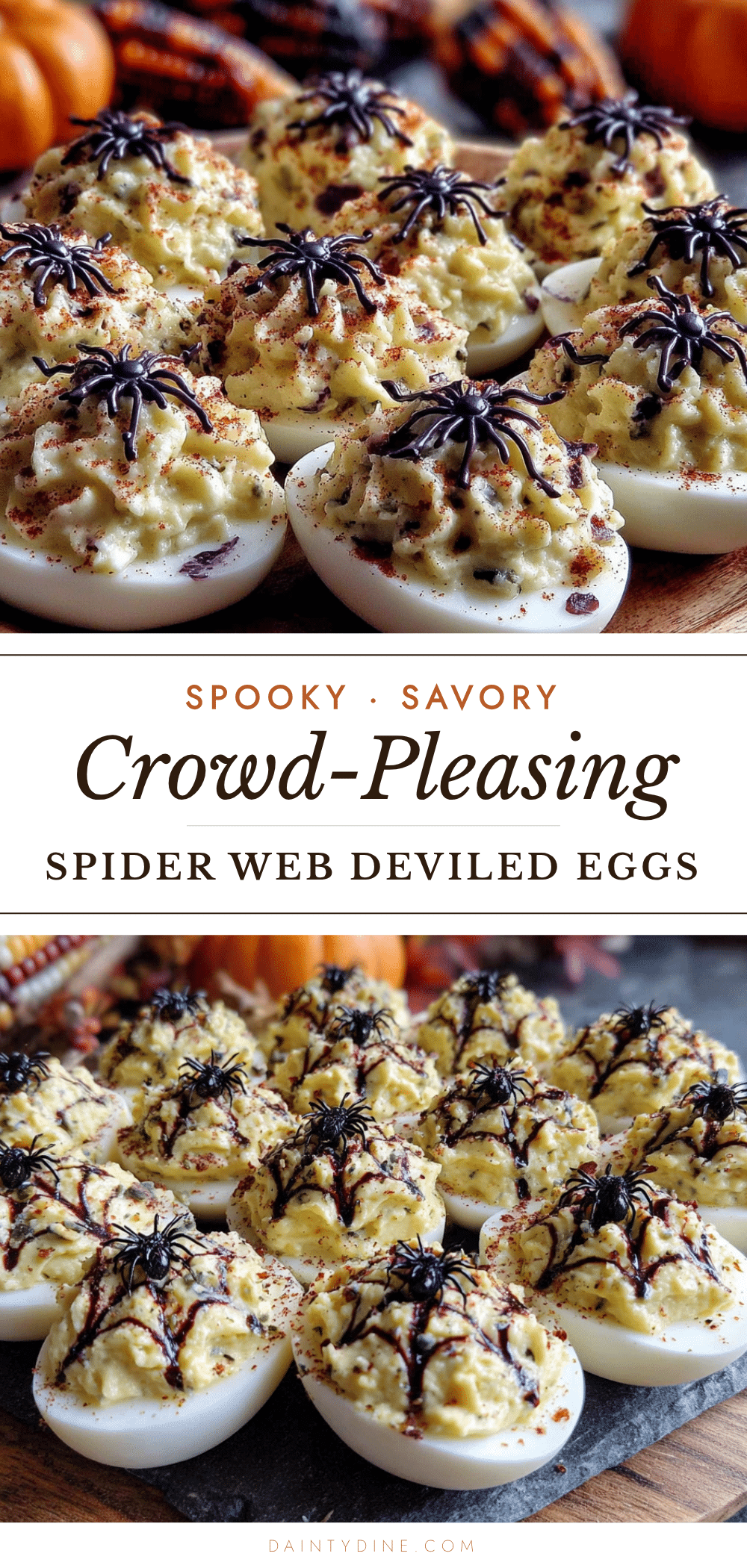
Best Spider Web Deviled Eggs for Halloween Fun
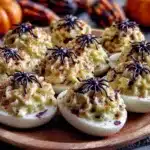
These spider web deviled eggs are the perfect Halloween appetizer—creamy, tangy filling topped with a dramatic sour cream web and a black olive spider. They’re surprisingly easy to make and guaranteed to be the star of any spooky gathering.
- Prep Time: 20 minutes
- Cook Time: 12 minutes
- Total Time: 47 minutes
- Yield: 24 servings 1x
- Category: Appetizer
- Cuisine: American
Ingredients
- 12 large eggs
- 1/3 cup mayonnaise
- 1 tablespoon yellow mustard
- 1 teaspoon pickle juice
- 1/4 teaspoon smoked paprika
- 1/8 teaspoon salt
- 1/8 teaspoon black pepper
- 1/4 cup sour cream
- 1 can (2.25 ounces) sliced black olives
- Fresh chives or parsley (optional, for garnish)
Instructions
- Hard-boil the eggs: Place eggs in a single layer in a large pot, cover with cold water by 1 inch. Bring to a rolling boil over high heat (8-10 minutes). Turn off heat, cover, and let sit for 12 minutes. Meanwhile, prepare an ice bath. Transfer eggs to ice bath and cool completely (at least 15 minutes).
- Peel the eggs: Tap each egg on the counter to crack the shell, roll between palms, and peel starting from the wider end. Run under cold water while peeling if needed.
- Prepare the eggs: Slice each egg in half lengthwise. Pop out yolks into a medium bowl. Arrange egg white halves on a serving platter, cut side up. Pat dry with paper towels.
- Make the filling: Add mayonnaise, yellow mustard, pickle juice, smoked paprika, salt, and pepper to the yolks. Mash with a fork until smooth and creamy (about 2 minutes). Taste and adjust seasoning.
- Fill the egg whites: Transfer filling to a piping bag or zip-top bag with a corner snipped off. Pipe filling into each egg white half, mounding slightly above the edge.
- Create the spider webs: Place sour cream in a small piping bag or squeeze bottle. Pipe three concentric circles of sour cream on each filled egg (small in center, medium around that, large near edge). Use a toothpick to drag from the center outward through all three circles to the edge. Repeat in 6-8 evenly spaced places. Wipe toothpick clean between each drag.
- Add the spiders: Place one sliced black olive in the center of each web.
- Garnish and serve: Sprinkle with a tiny pinch of smoked paprika and fresh chives or parsley if desired. Serve immediately or refrigerate for up to 2 hours. Bring to room temperature about 20 minutes before serving.
Notes
Use full-fat sour cream for the web design; low-fat is too runny. For make-ahead, prepare filled eggs without webs up to 2 days in advance, then add webs and olives just before serving. If transporting, cover loosely with plastic wrap that doesn’t touch the webs.
Nutrition
- Serving Size: 1 deviled egg
- Calories: 65
- Sugar: 0.5
- Sodium: 120
- Fat: 4.5
- Saturated Fat: 1
- Carbohydrates: 1
- Protein: 5
Keywords: Halloween deviled eggs, spider web deviled eggs, spooky appetizer, Halloween party food, deviled eggs recipe