Love this? Save it for later!
Share the inspiration with your friends
My neighbor, Carol, had claimed to hate sweet potato casserole for thirty-seven years. Thirty-seven years! She’d make a face every time someone brought it to a potluck, muttering something about “marshmallow goo” and “ruining a perfectly good vegetable.” I believed her, honestly. I mean, who would lie about hating a dish for that long? Then, last Thanksgiving, I made this version just for myself—a make-ahead version, because I refuse to be chained to the oven on the big day. I left it on the counter to cool, stepped away for maybe five minutes, and came back to find Carol, fork in hand, mid-bite. She froze, caught red-handed. “This doesn’t count,” she said, pointing the fork at me. “This is different.” And you know what? She was right. It is different.
That moment—catching someone in the act of proving themselves wrong—is exactly why I keep making this casserole. It’s not the overly sweet, mushy stuff from your grandma’s church cookbook. It’s a savory-sweet masterpiece with a buttery pecan topping that shatters when you bite into it. The sweet potatoes are roasted, not boiled, which concentrates their natural sugars and gives them a silky, almost caramelized texture. And the best part? You can make it three days ahead. Three days! That means less stress, more time with the people you actually like, and a side dish that tastes like you spent all day in the kitchen when you really just threw it together on a Tuesday afternoon. I’ve been making this for six years now, and honestly, it’s the only thing I’m asked to bring to every single holiday gathering. Maybe you’ve been there—the one dish everyone expects, the one that disappears first. That’s this casserole.
Why You’ll Love This Recipe
Let’s be real for a second. There are a million sweet potato casserole recipes out there. Some are too sweet, some are too mushy, and some just don’t deliver on that promised crunch. This one is different, and here’s why you’ll actually want to make it:
- Truly Make-Ahead Friendly: This isn’t one of those “make-ahead” recipes that actually tastes worse the next day. The flavors meld and deepen in the fridge, making it even better on day two or three. You can assemble it up to 72 hours in advance and bake it when you’re ready.
- Simple, Real Ingredients: No canned soup, no Jell-O, no weird shortcuts. Just sweet potatoes, butter, cream, eggs, and a pecan topping that uses real maple syrup. You probably have most of this in your kitchen right now.
- Perfect for Stress-Free Holidays: Thanksgiving, Christmas, Easter—whatever you’re celebrating, this dish frees up your oven and your sanity. Bake it while the turkey rests, or reheat it while the ham finishes glazing.
- Crowd-Pleasing Texture: The filling is creamy but not mushy, thanks to roasting instead of boiling. The topping is crunchy but not hard, thanks to a perfect ratio of pecans to butter to flour. Every bite has contrast.
- Unbelievably Delicious: I’m not supposed to play favorites with recipes, but this one? It’s the one I’d grab from a burning kitchen. The combination of smoky roasted sweet potatoes, rich custard, and nutty brown sugar topping is pure comfort.
What makes this recipe my best version is the technique. Roasting the sweet potatoes instead of boiling them removes excess moisture, which means your casserole won’t turn into a watery mess. Blending the filling until it’s silky smooth gives it a texture closer to a soufflé than a mashed potato pile. And the pecan topping—I tested it seven times to get the ratio right. Seven times. My family is still finding pecan crumbs in weird places, but it was worth it.
This is the kind of recipe that makes you close your eyes after the first bite. It’s comfort food reimagined—richer, more complex, but with the same soul-soothing satisfaction. Perfect for impressing your mother-in-law without breaking a sweat, or turning a simple Sunday dinner into something memorable.
What Ingredients You Will Need
This recipe uses simple, wholesome ingredients to deliver bold flavor and satisfying texture without the fuss. Most of these are pantry staples, but I’ll point out a few key choices that make a real difference.
- Sweet Potatoes (3 pounds, about 4-5 medium): Look for firm, evenly shaped sweet potatoes with smooth skin. I prefer the orange-fleshed variety (often labeled “garnet” or “jewel”) for their natural sweetness and creamy texture when roasted. Avoid the pale-fleshed ones—they’re starchier and less sweet.
- Unsalted Butter (6 tablespoons, softened): I use unsalted butter to control the salt level. If you only have salted, reduce the added salt in the filling to ¼ teaspoon. I recommend Kerrygold or Plugrà for their higher fat content, which makes the filling richer.
- Large Eggs (2, room temperature): Room temperature eggs blend more smoothly into the filling. If you forgot to take them out of the fridge, place them in a bowl of warm water for 5 minutes.
- Heavy Cream (½ cup): This adds richness and helps create that silky, almost custard-like texture. You can substitute half-and-half in a pinch, but the filling will be slightly less luxurious.
- Pure Maple Syrup (¼ cup): Use the real stuff, not pancake syrup. Grade A dark amber works beautifully here. The maple flavor is subtle but adds depth that plain sugar can’t match.
- Light Brown Sugar (¼ cup, packed): This goes into the filling for a touch of molasses flavor. Dark brown sugar works too, but will make the filling slightly darker and more intensely flavored.
- Vanilla Extract (1 teaspoon): Pure vanilla, not imitation. It rounds out the flavors and makes the sweetness taste more complex.
- Salt (½ teaspoon): Don’t skip this. Salt is what prevents the casserole from tasting flat or one-dimensionally sweet.
- Ground Cinnamon (½ teaspoon) and Nutmeg (¼ teaspoon, freshly grated if possible): These warm spices complement the sweet potatoes without overwhelming them. Freshly grated nutmeg makes a noticeable difference—it’s more aromatic and less dusty-tasting.
For the Pecan Topping:
- Pecans (1 cup, chopped): I prefer pecan halves that I chop myself—they stay chunkier and more textured than pre-chopped pecans, which can be powdery. Toast them lightly in a dry pan for 3-4 minutes to deepen their flavor.
- All-Purpose Flour (⅓ cup): This helps the topping hold together and creates that crumbly, streusel-like texture. For a gluten-free version, use a 1:1 gluten-free flour blend.
- Light Brown Sugar (⅓ cup, packed): More brown sugar here for that caramelized crunch.
- Unsalted Butter (3 tablespoons, cold, cut into small cubes): Cold butter is key for a crumbly topping. If the butter softens, the topping will turn into a paste instead of staying pebbly.
- Ground Cinnamon (½ teaspoon): A little extra spice in the topping ties everything together.
Substitution Guidance: For a dairy-free version, use vegan butter (I like Miyoko’s) and full-fat coconut cream instead of heavy cream. For a lower-sugar option, reduce the maple syrup to 2 tablespoons and use a sugar substitute like Swerve in the topping. The texture will be slightly less tender, but the flavor will still be excellent.
Equipment Needed
You don’t need a fancy kitchen to pull this off. Here’s what you’ll actually use:
- Baking Sheet: For roasting the sweet potatoes. A rimmed sheet is best to catch any sticky drips.
- 9×13-inch Baking Dish: This is the standard size for this casserole. Glass or ceramic works best—metal can sometimes react with the sweet potatoes and give a slight metallic taste.
- Food Processor or High-Speed Blender: This is the secret to that silky-smooth texture. A potato masher will work in a pinch, but you’ll get a chunkier, less luxurious result. I’ve used my Cuisinart for years and it’s never let me down.
- Large Mixing Bowl: For combining the topping ingredients.
- Pastry Cutter or Two Forks: For cutting the cold butter into the flour mixture for the topping. Your hands work too, but work quickly so the butter doesn’t soften.
- Aluminum Foil: For covering the casserole if the topping browns too quickly.
- Spatula: A rubber spatula for scraping every last bit of filling into the dish. Waste not, want not.
If you don’t have a food processor, you can use a potato ricer followed by vigorous whisking. It takes more elbow grease, but the result is still creamy. And if you’re buying a baking dish specifically for this, go with a 3-quart Pyrex—it’s cheap, durable, and perfect for this recipe.
Preparation Method
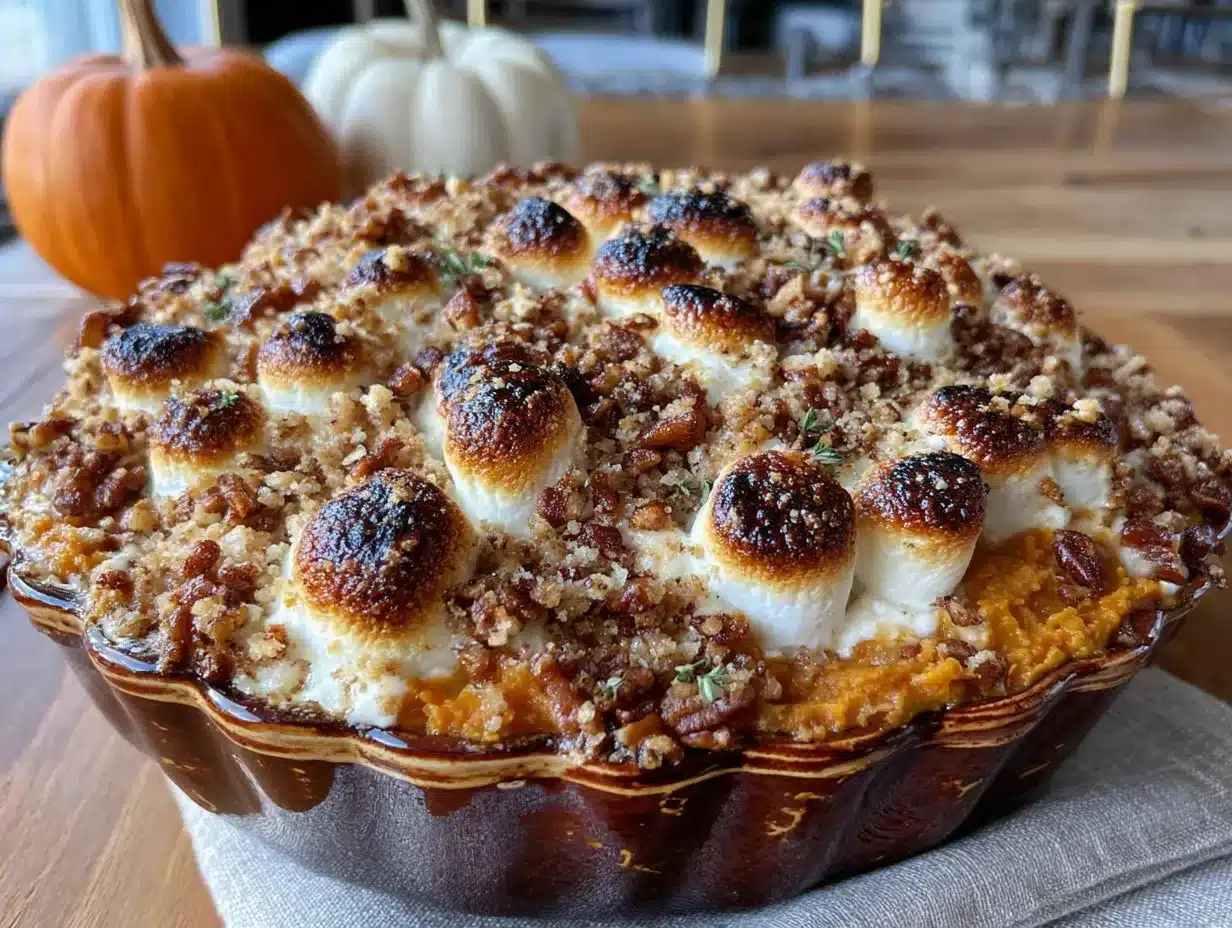
Let’s walk through this step by step. I’ve made this casserole more times than I can count, and these are the exact steps I follow every time.
- Roast the Sweet Potatoes (1 hour 15 minutes): Preheat your oven to 400°F (200°C). Scrub the sweet potatoes clean—don’t peel them yet. Prick each one 4-5 times with a fork to let steam escape. Place them directly on the oven rack with a baking sheet on the rack below to catch any drips. Roast for 60-75 minutes, until they’re very soft and a knife slides in with zero resistance. The skins will look wrinkled and might be leaking a little syrupy liquid—that’s good. Let them cool until you can handle them, about 20 minutes. Pro tip: Roasting concentrates the sugars and removes excess moisture. Boiling makes them waterlogged and dilutes the flavor. Trust me on this one.
- Prepare the Filling Base (10 minutes): Once the sweet potatoes are cool enough to handle, peel off the skins. They should slip off easily—if they don’t, your potatoes weren’t roasted long enough. Place the flesh in your food processor. Add 6 tablespoons softened unsalted butter, 2 room-temperature eggs, ½ cup heavy cream, ¼ cup pure maple syrup, ¼ cup packed light brown sugar, 1 teaspoon vanilla extract, ½ teaspoon salt, ½ teaspoon cinnamon, and ¼ teaspoon nutmeg. Process until completely smooth, about 2 minutes. Stop and scrape down the sides halfway through. The mixture should be glossy, smooth, and a beautiful deep orange. Note: If your mixture looks curdled, your eggs were too cold. Don’t panic—it will smooth out once baked.
- Make the Pecan Topping (5 minutes): In a medium bowl, combine 1 cup chopped pecans, ⅓ cup all-purpose flour, ⅓ cup packed light brown sugar, and ½ teaspoon cinnamon. Add 3 tablespoons cold butter, cut into small cubes. Use a pastry cutter or two forks to cut the butter into the dry ingredients until the mixture resembles coarse meal with some pea-sized butter pieces remaining. Don’t overwork it—you want some texture. The topping should look crumbly, not like a paste. Personal tip: I sometimes pop the bowl in the freezer for 5 minutes if my kitchen is warm. Cold topping = crunchier topping.
- Assemble the Casserole (5 minutes): Grease your 9×13-inch baking dish with butter or non-stick spray. Pour the sweet potato filling into the dish and spread it evenly with a spatula. Sprinkle the pecan topping evenly over the surface. Don’t press it down—let it sit loosely on top so it gets crunchy. At this point, you can cover the dish with plastic wrap (make sure it doesn’t touch the topping) and refrigerate for up to 3 days, or bake immediately.
- Bake the Casserole (35-40 minutes): If baking immediately, preheat your oven to 350°F (175°C). Bake uncovered for 35-40 minutes, until the filling is set around the edges and slightly jiggly in the center (it will continue to set as it cools). The topping should be deep golden brown and fragrant. If the topping is browning too quickly after 25 minutes, tent loosely with foil for the remaining time. Sensory cue: Your kitchen will smell like toasted pecans, brown sugar, and something almost like a bakery. That’s how you know it’s working.
- Rest Before Serving (10-15 minutes): Let the casserole rest on a wire rack for at least 10 minutes before serving. This allows the filling to set properly. If you cut into it too soon, it will be runny. I learned this the hard way when I served it at a Friendsgiving and it slid right off the spoon.
Make-Ahead Instructions: To bake from refrigerated, remove the casserole from the fridge 30 minutes before baking to take the chill off. Bake at 350°F (175°C) for 40-45 minutes, adding 5-10 minutes to the baking time. If the topping starts browning too fast, cover loosely with foil.
Cooking Tips & Techniques
After years of trial and error—and believe me, there was error—here are the things I wish someone had told me from the start.
Don’t Skip Roasting the Potatoes. I know it takes longer than boiling. I know you’re busy. But roasting is non-negotiable for the best texture. Boiled sweet potatoes absorb water like a sponge, and that water dilutes the flavor and makes the filling loose. Roasted sweet potatoes are concentrated, sweet, and almost caramelized. The difference is night and day.
Temperature Matters More Than You Think. Cold eggs and cold cream can cause your filling to seize up in the food processor. Take everything out of the fridge 30 minutes before you start. If you forget, place the eggs in warm water and microwave the cream for 10 seconds—just until it’s no longer cold to the touch.
The Butter for the Topping Must Be Cold. I cannot stress this enough. Warm butter will turn your topping into a greasy, sandy mess. Cut the butter into small cubes and pop them in the freezer for 10 minutes before you start. Your topping will stay pebbly and crunchy instead of melting into the filling.
Don’t Overmix the Topping. You want some pea-sized butter pieces remaining. Those little pockets of butter melt in the oven and create steam, which makes the topping light and crunchy instead of dense. Overmixing = hockey puck topping. I’ve been there. It’s sad.
Let It Rest. This is the hardest part, I know. The casserole smells amazing, everyone is hungry, and you just want to dig in. But resting allows the filling to set up properly. If you cut into it too soon, it will be loose and soupy. Give it 10-15 minutes. Use that time to set the table or pour yourself a glass of wine.
Variations & Adaptations
One of the best things about this casserole is how adaptable it is. Here are a few ways I’ve changed it up over the years:
- Savory-Sweet Version: Reduce the maple syrup to 2 tablespoons and the brown sugar to 2 tablespoons. Add 1 teaspoon fresh thyme leaves and ½ teaspoon black pepper to the filling. Top with the pecan mixture but add 2 tablespoons grated Parmesan cheese to the topping. The result is a more grown-up, savory side dish that pairs beautifully with roast pork or chicken.
- Vegan Adaptation: Replace the butter with vegan butter (Miyoko’s is my favorite). Use ½ cup full-fat coconut cream instead of heavy cream. Replace the eggs with 2 tablespoons ground flaxseed mixed with 6 tablespoons water—let it sit for 5 minutes to thicken before adding to the processor. The texture will be slightly less rich, but the flavor is still outstanding.
- Bourbon-Pecan Twist: Add 2 tablespoons bourbon to the filling along with the other ingredients. The alcohol bakes off, leaving behind a warm, smoky depth that complements the sweet potatoes beautifully. I tried this on a whim one Christmas and it was a huge hit.
- Individual Ramekins: For a fancier presentation, divide the filling among 8 (6-ounce) ramekins. Top each with the pecan mixture and bake for 20-25 minutes. These are perfect for dinner parties where everyone wants their own little dish.
- Gluten-Free Option: Use a 1:1 gluten-free flour blend (I like King Arthur’s) in the topping. The texture will be slightly more crumbly, but the flavor is identical. Make sure all other ingredients are certified gluten-free if needed.
Serving & Storage Suggestions
Serving: This casserole is best served warm, not hot. Let it rest for 10-15 minutes after baking, then serve it alongside your holiday mains—roast turkey, glazed ham, or even a simple roast chicken. It also pairs beautifully with green bean casserole, roasted Brussels sprouts, and a tangy cranberry sauce to cut through the richness. For a truly stunning presentation, garnish with a few whole toasted pecan halves and a light dusting of cinnamon just before serving.
Storage: Leftovers keep beautifully. Store covered in the refrigerator for up to 5 days. The topping will soften slightly, but the flavor will deepen. To reheat, place individual portions in a 350°F (175°C) oven for 10-15 minutes, or microwave for 60-90 seconds. For larger portions, cover with foil and reheat at 325°F (160°C) for 20 minutes.
Freezing: This casserole freezes exceptionally well. Assemble completely (including the topping) but do not bake. Wrap tightly in plastic wrap, then a layer of foil. Freeze for up to 3 months. To bake from frozen, remove the plastic wrap, cover with foil, and bake at 350°F (175°C) for 60-70 minutes, removing the foil for the last 15 minutes. Alternatively, thaw overnight in the refrigerator and bake as directed, adding 5-10 minutes to the baking time.
Flavor Development: Here’s a secret—this casserole actually tastes better on day two. The flavors meld and deepen as it sits. If you’re making it for a big meal, I highly recommend making it a day ahead. Your future self will thank you.
Nutritional Information & Benefits
While this is definitely a comfort food dish, it does have some redeeming qualities. Here’s the estimated nutritional breakdown per serving (based on 12 servings):
- Calories: 310
- Total Fat: 18g
- Saturated Fat: 8g
- Carbohydrates: 36g
- Fiber: 4g
- Sugar: 18g
- Protein: 4g
- Vitamin A: 380% DV
- Vitamin C: 15% DV
- Potassium: 450mg
Sweet potatoes are packed with beta-carotene, which your body converts to vitamin A—essential for eye health and immune function. They’re also a good source of fiber, which helps with digestion and keeps you feeling full. The pecans add healthy monounsaturated fats and a dose of magnesium. That said, this is a special occasion dish, not an everyday health food. I balance it out by serving lighter sides alongside, like a simple green salad or roasted vegetables.
Dietary Considerations: This recipe contains dairy, eggs, gluten (in the topping), and tree nuts (pecans). For allergen-friendly adaptations, see the Variations section above.
Conclusion
Look, I know there are a lot of sweet potato casserole recipes out there. I’ve tried dozens of them—some too sweet, some too mushy, some that just didn’t deliver that perfect crunch. But this one? This is the one I keep coming back to. It’s the one I make for Thanksgiving, for Christmas, for Easter brunch, and sometimes just for a random Tuesday when I need a little comfort.
What I love most about this recipe is how forgiving it is. You can make it ahead, you can tweak it to your taste, and it still turns out beautifully every single time. It’s the kind of dish that makes you look like a hero in the kitchen without actually having to do much work. And honestly? That’s my favorite kind of recipe.
I’d love to hear how yours turns out. Did you add bourbon? Go the savory route? Make it for a crowd? Drop a comment below and let me know—I read every single one, and I love seeing how you make this recipe your own. And if you really love it, share it with a friend who needs a little less stress in their holiday cooking. Happy cooking, friends!
Frequently Asked Questions
Can I use canned sweet potatoes instead of fresh?
You can, but I really don’t recommend it. Canned sweet potatoes are packed in water or syrup, which makes them much wetter and less flavorful than roasted fresh ones. The texture will be looser and the flavor will be noticeably less sweet and complex. If you’re in a desperate pinch, drain them very well and pat them dry with paper towels before using. But honestly, roasting fresh sweet potatoes is so easy and makes such a difference—it’s worth the extra time.
Why did my topping turn out soggy?
This usually happens for one of two reasons. Either your butter was too warm when you made the topping (it should be cold), or you pressed the topping down into the filling instead of sprinkling it loosely on top. The topping needs to sit on the surface, not sink into the filling, so it can crisp up in the oven. If your topping is already on and you’re worried, you can tent the casserole with foil for the first 20 minutes of baking, then remove the foil to let the topping crisp.
Can I make this casserole without a food processor?
Absolutely. If you don’t have a food processor or blender, you can mash the roasted sweet potatoes by hand with a potato masher or ricer. It will take a bit more effort, and the texture won’t be quite as silky smooth, but it will still be delicious. Just make sure to mash until there are no lumps, then whisk in the remaining ingredients vigorously until everything is well combined.
How far ahead can I make this casserole?
You can assemble the casserole completely (including the topping) up to 3 days in advance. Keep it covered tightly with plastic wrap in the refrigerator. When you’re ready to bake, remove the plastic wrap and let it sit at room temperature for 30 minutes while your oven preheats. You’ll need to add about 5-10 minutes to the baking time since you’re starting from cold. The flavor actually improves as it sits, so this is a great make-ahead option for busy holidays.
Can I double this recipe?
Yes! This recipe doubles beautifully. Use a larger baking dish (a 10×15-inch or two 9×13-inch dishes) and increase the baking time by about 10-15 minutes. Just make sure your topping is spread evenly and that the filling is set around the edges before you pull it out of the oven. If you’re feeding a crowd, this is the perfect recipe to scale up.
Pin This Recipe!
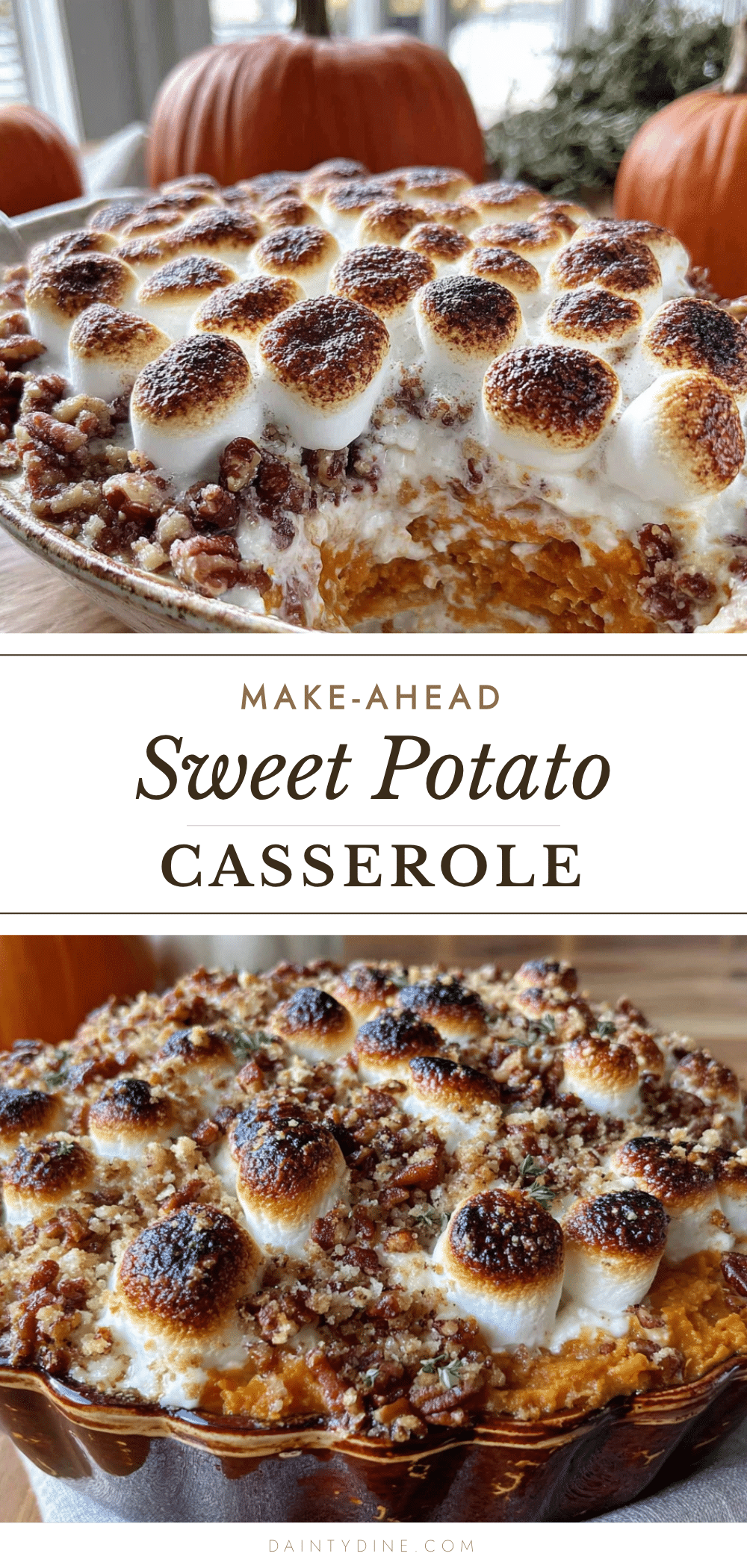
Perfect Make-Ahead Sweet Potato Casserole
A savory-sweet sweet potato casserole with a buttery pecan topping that can be made up to three days ahead. Roasted sweet potatoes create a silky, caramelized texture, making it a stress-free holiday side dish.
- Prep Time: 20 minutes
- Cook Time: 1 hour 15 minutes (roasting) + 35-40 minutes (baking)
- Total Time: 2 hours 10 minutes (including cooling)
- Yield: 12 servings 1x
- Category: Side Dish
- Cuisine: American
Ingredients
- 3 pounds sweet potatoes (about 4–5 medium)
- 6 tablespoons unsalted butter, softened
- 2 large eggs, room temperature
- ½ cup heavy cream
- ¼ cup pure maple syrup
- ¼ cup light brown sugar, packed
- 1 teaspoon vanilla extract
- ½ teaspoon salt
- ½ teaspoon ground cinnamon
- ¼ teaspoon ground nutmeg (freshly grated if possible)
- 1 cup pecans, chopped
- ⅓ cup all-purpose flour
- ⅓ cup light brown sugar, packed
- 3 tablespoons unsalted butter, cold and cut into small cubes
- ½ teaspoon ground cinnamon
Instructions
- Roast the sweet potatoes: Preheat oven to 400°F (200°C). Scrub sweet potatoes clean and prick each 4-5 times with a fork. Place directly on oven rack with a baking sheet on the rack below to catch drips. Roast for 60-75 minutes until very soft. Let cool until handleable, about 20 minutes.
- Prepare the filling base: Peel roasted sweet potatoes and place flesh in a food processor. Add 6 tablespoons softened butter, 2 room-temperature eggs, ½ cup heavy cream, ¼ cup maple syrup, ¼ cup packed brown sugar, 1 teaspoon vanilla, ½ teaspoon salt, ½ teaspoon cinnamon, and ¼ teaspoon nutmeg. Process until completely smooth, about 2 minutes, scraping down sides halfway.
- Make the pecan topping: In a medium bowl, combine 1 cup chopped pecans, ⅓ cup flour, ⅓ cup packed brown sugar, and ½ teaspoon cinnamon. Add 3 tablespoons cold butter cubes. Use a pastry cutter or two forks to cut butter into dry ingredients until mixture resembles coarse meal with some pea-sized butter pieces. Do not overwork.
- Assemble the casserole: Grease a 9×13-inch baking dish. Pour sweet potato filling into dish and spread evenly. Sprinkle pecan topping evenly over surface without pressing down. Cover with plastic wrap (not touching topping) and refrigerate up to 3 days, or bake immediately.
- Bake the casserole: If baking immediately, preheat oven to 350°F (175°C). Bake uncovered for 35-40 minutes until filling is set around edges and slightly jiggly in center, and topping is deep golden brown. If topping browns too quickly after 25 minutes, tent loosely with foil.
- Rest before serving: Let casserole rest on a wire rack for at least 10-15 minutes before serving to allow filling to set properly.
Notes
Roasting sweet potatoes instead of boiling concentrates sugars and removes excess moisture. Use room temperature eggs and cream to prevent filling from seizing. Keep topping butter cold for a crunchy texture. Let casserole rest before serving to set properly. Flavor improves on day two.
Nutrition
- Serving Size: 1 serving (1/12 of c
- Calories: 310
- Sugar: 18
- Sodium: 210
- Fat: 18
- Saturated Fat: 8
- Carbohydrates: 36
- Fiber: 4
- Protein: 4
Keywords: sweet potato casserole, make-ahead, holiday side dish, pecan topping, Thanksgiving, Christmas, comfort food