Love this? Save it for later!
Share the inspiration with your friends
Christmas Eve was in twelve hours and I had completely forgotten to pick up the roast. My mother-in-law, a woman who once made a six-course dinner from a broken oven, was coming over. Everyone else would be bringing something elaborate—my sister-in-law’s famous truffle mac, my brother’s bourbon-glazed ham. I had a grocery store parking lot, a phone with 3% battery, and absolutely no plan.
I walked into the meat section like a woman possessed, grabbed the biggest prime rib I could find, and honestly, I just stood there. I mean, I’ve cooked roasts before, but never for *this* audience. You know that feeling when you’re about to serve something to people who actually know food? Yeah, that was me. I grabbed a head of garlic, some fresh herbs from the sad little produce section, and thought, “Well, this is either going to be a miracle or a disaster.”
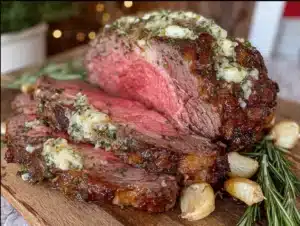
Turns out, it was a miracle. A garlic herb prime rib roast that came out so juicy, so perfectly pink in the middle, with that gorgeous golden-brown crust—my mother-in-law asked for the recipe. Twice. My brother, who never compliments anything that isn’t deep-fried, went back for thirds. And I stood there, sheepish, knowing full well I’d just stumbled into the best roast of my life by accident.
That’s the thing about this perfect garlic herb prime rib roast. It doesn’t need fancy techniques or a culinary degree. It just needs the right ingredients, a little patience, and maybe a little bit of panic to get the timing right. If you’ve ever felt that pressure to impress, or just wanted a holiday meal that feels like a hug on a plate, this one’s for you.
Why You’ll Love This Recipe
This isn’t just another prime rib recipe. I’ve tested this method about seven times now—once with a cheaper cut, once with a different herb blend, once when I forgot to let it rest (don’t do that). This version is the one that works every single time, and here’s why it’s become my go-to for every special occasion.
- Foolproof Method: The reverse-sear technique takes the stress out of cooking a large roast. You get an evenly cooked interior and a gorgeous crust without hovering over the oven.
- Simple Ingredients: You don’t need a specialty butcher or imported herbs. Garlic, rosemary, thyme, salt, pepper—these are pantry heroes that do all the heavy lifting.
- Perfect for Holidays: Christmas, New Year’s, Easter, or a really good Tuesday—this roast feels like an event without requiring you to be in the kitchen all day.
- Crowd-Pleaser: I’ve served this to picky eaters, steak snobs, and people who “don’t really like red meat.” It disappears every time.
- Unbelievably Juicy: The low-and-slow method locks in moisture so every slice is tender, flavorful, and anything but dry.
What makes this different from the hundreds of other prime rib recipes out there? It’s the garlic herb butter that gets rubbed all over the roast before it hits the oven. Not just a quick slather—a proper massage that works the flavor deep into every crevice. And the resting technique? That’s the secret weapon. I learned it from a chef friend who told me, “The roast doesn’t stop cooking when you pull it out. Give it time to relax.” That one piece of advice changed everything.
This is the kind of recipe that makes you close your eyes after the first bite. It’s comfort food at its finest—rich, savory, and deeply satisfying. It’s the meal you serve when you want to say “I love you” without actually saying it. And honestly, it’s the recipe that made my mother-in-law finally admit I might be a decent cook.
What Ingredients You Will Need
This recipe uses simple, high-quality ingredients to build layers of flavor without any fuss. Most of these are likely already in your kitchen, which is exactly how a stress-free holiday meal should start.
For the Garlic Herb Butter
- Unsalted butter, softened (1/2 cup / 113g) – Make sure it’s truly soft, not melted. Room temperature butter creates a paste that sticks to the meat beautifully.
- Garlic cloves, minced (6-8 large cloves) – Fresh garlic is non-negotiable here. The jarred stuff just won’t give you that punchy, aromatic flavor.
- Fresh rosemary, finely chopped (2 tablespoons) – I prefer to strip the leaves off the stem and chop them fine. Dried rosemary is too woody for this application.
- Fresh thyme leaves (1 tablespoon) – Run your fingers down the stem to release the leaves. It’s oddly satisfying.
- Kosher salt (2 teaspoons) – I use Diamond Crystal. It’s less salty by volume than table salt, so if you’re using a different brand, adjust accordingly.
- Freshly ground black pepper (1 teaspoon) – Please don’t use pre-ground pepper. The fresh stuff makes a real difference in the crust.
- Dijon mustard (1 tablespoon) – This is my little trick. It adds a subtle tang and helps the herb crust adhere to the meat.
For the Prime Rib Roast
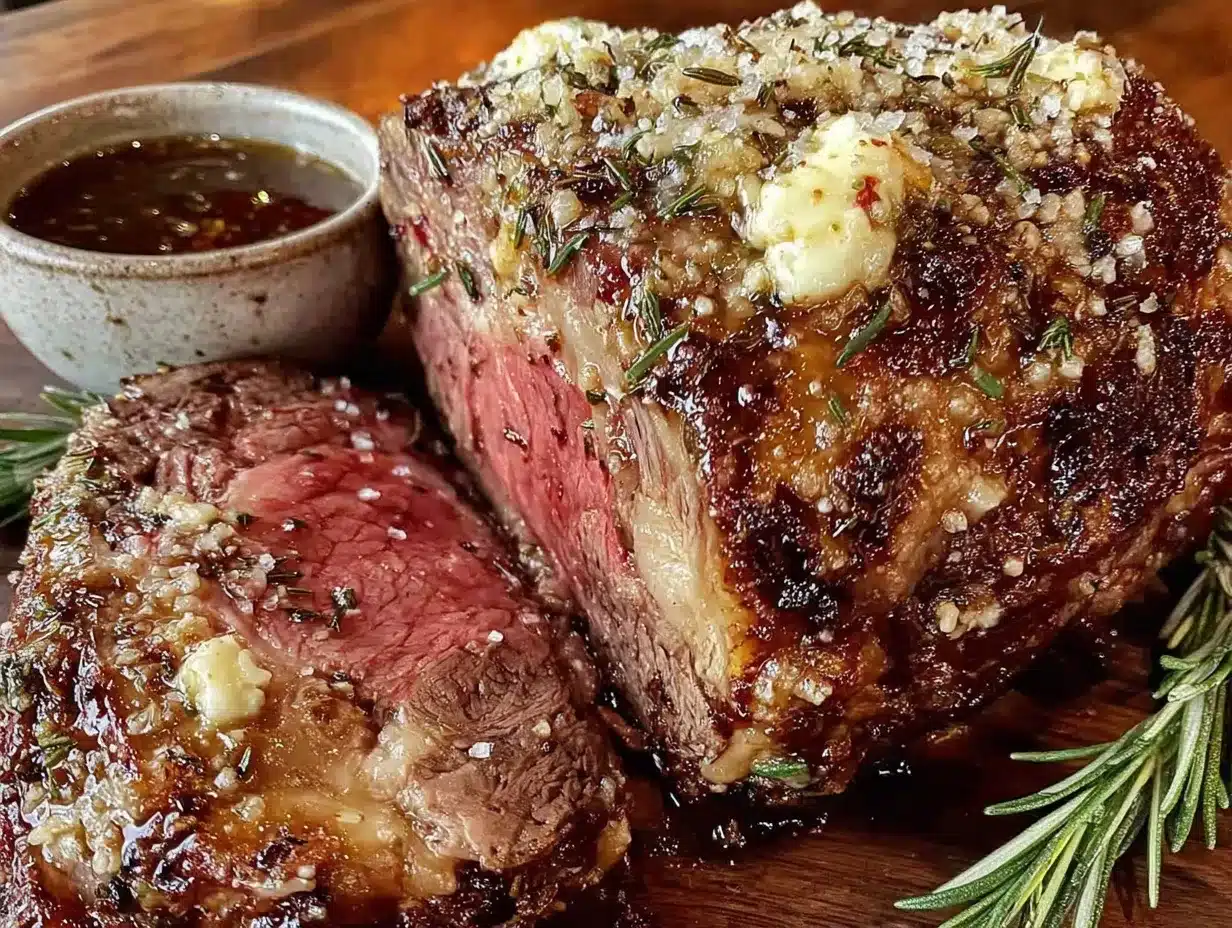
- Bone-in prime rib roast (4-5 pounds / 1.8-2.3 kg) – I recommend asking your butcher for a roast from the rib section, bones attached. The bones add flavor and act as a natural roasting rack.
- Olive oil (2 tablespoons) – Just a good quality extra virgin. You’re not frying, just helping the seasoning stick.
- Additional kosher salt and black pepper – For a final seasoning before roasting.
- Beef broth or red wine (1 cup / 240ml) – For the pan. This creates a natural jus that you can serve alongside the roast.
Ingredient Selection Tips: When buying your prime rib, look for one with good marbling—those thin white lines running through the meat. That’s fat, and fat equals flavor and moisture. I personally prefer buying from a local butcher or a high-end grocery store like Whole Foods. The quality difference is noticeable. If you’re on a budget, a choice-grade roast works fine, just be extra careful not to overcook it.
Substitution Guidance: Need a dairy-free option? Use vegan butter or ghee (clarified butter has less lactose). For a stronger herb flavor, add a tablespoon of fresh oregano or sage. If you don’t have Dijon mustard, a teaspoon of Worcestershire sauce adds a similar depth. And if you’re out of fresh herbs altogether, use half the amount of dried—but honestly, fresh is where the magic happens here.
Equipment Needed
You don’t need a professional kitchen to pull this off. Here’s what I use every time I make this garlic herb prime rib roast.
- Roasting pan with a rack – A rack lifts the roast off the bottom so heat circulates evenly. No rack? Roll up a few foil strips and place them under the roast.
- Instant-read meat thermometer – This is non-negotiable. Guessing doneness with a prime rib is a recipe for disaster. I use a Thermapen and it’s worth every penny.
- Chef’s knife – A sharp 8-inch knife makes mincing garlic and herbs a breeze. Dull knives are dangerous—and frustrating.
- Cutting board – Preferably wooden or plastic. Have a separate one for raw meat.
- Aluminum foil – For tenting the roast during the resting phase.
- Kitchen twine – Optional, but helpful for tying the roast into a uniform shape for even cooking.
- Small bowl – For mixing the herb butter.
- Carving knife or slicing knife – A long, thin blade gives you clean, even slices.
Budget-Friendly Options: If you don’t own a roasting rack, a wire cooling rack placed inside a rimmed baking sheet works perfectly. No instant-read thermometer? You can pick up a decent one for under $15 at most grocery stores. Trust me, it’s a better investment than guessing and ending up with a well-done roast when you wanted medium-rare.
Preparation Method
Let’s get cooking. This method works best if you start at least 4 hours before you plan to serve, but most of that time is hands-off. You’ve got this.
- Take the roast out of the fridge 2 hours before cooking. This is the hardest part—the waiting. But a cold roast cooks unevenly. Let it sit on the counter, still wrapped, until it comes to room temperature. Pat it dry with paper towels. Moisture is the enemy of a good crust.
- Preheat your oven to 250°F (120°C). Yes, that low. We’re using the reverse-sear method, which means we cook the roast low and slow first, then blast it with high heat at the end.
- Make the garlic herb butter. In a small bowl, combine the softened butter, minced garlic, chopped rosemary, thyme leaves, kosher salt, black pepper, and Dijon mustard. Mash it together with a fork until it forms a uniform paste. Taste a tiny bit—it should be punchy and aromatic. If it tastes flat, add another pinch of salt.
- Season the roast. Rub the olive oil all over the roast. Then, take the garlic herb butter and massage it into every surface. Don’t be shy—get it into the crevices between the bones and the meat. This is where the flavor lives. If you have time, let the roast sit with the butter on it for 30 minutes at room temperature.
- Place the roast in the roasting pan. Set it bone-side down on the rack. The bones act as a natural insulator, protecting the meat from direct heat. Pour the beef broth or red wine into the bottom of the pan—not over the roast. This will create steam and a flavorful jus.
- Roast low and slow. Place the pan in the preheated oven and cook until the internal temperature reaches 115-120°F (46-49°C) for medium-rare. This typically takes about 2.5 to 3 hours for a 4-5 pound roast. Start checking the temperature after 2 hours using your instant-read thermometer inserted into the thickest part of the meat, avoiding the bone. The roast should feel slightly firm but still quite soft when pressed.
- Rest the roast (first rest). Once it hits your target temperature, remove the roast from the oven. Tent it loosely with aluminum foil and let it rest for 20-30 minutes. This is crucial—the internal temperature will rise another 5-10°F during this time (carryover cooking). Don’t skip this step or you’ll lose all those precious juices.
- Crank up the heat. While the roast rests, increase your oven temperature to 500°F (260°C). If your oven runs hot, 475°F (245°C) is fine. You want it screaming hot.
- The final sear. Remove the foil from the roast and place it back in the oven, uncovered. Roast for 8-12 minutes, watching closely. You’re looking for a deep golden-brown crust. The garlic and herbs will sizzle and smell incredible. Don’t walk away—this happens fast and can burn quickly.
- Second rest. Remove the roast from the oven and tent it again with foil. Let it rest for another 10-15 minutes. This allows the juices to redistribute after the high-heat blast. Patience, my friend.
- Carve and serve. Transfer the roast to a cutting board. Use a sharp knife to cut the bones away from the meat in one piece. Then slice the meat against the grain into 1/2-inch thick slices. Arrange on a platter, spoon some of the pan juices over the top, and watch everyone’s eyes light up.
Sensory Cues: When you first rub the herb butter on the roast, it should feel like you’re giving it a fragrant, garlicky massage. During the low-temperature roast, your kitchen will slowly fill with the aroma of roasting beef and herbs—not overpowering, but warm and inviting. When you pull it out for the final sear, the crust should look pale golden, not dark. After the high-heat blast, you want a deep mahogany color that crackles slightly when you press it.
Cooking Tips & Techniques
I’ve made every mistake in the book with prime rib, so you don’t have to. Here’s what I’ve learned the hard way.
Don’t skip the salting. I once thought, “Eh, I’ll just add salt at the table.” Big mistake. Salting the roast ahead of time—even just an hour—draws moisture to the surface, which then evaporates, leaving you with a better crust. If you can, salt the roast the night before and leave it uncovered in the fridge. That’s the ultimate pro move.
The biggest mistake I see is overcooking. People get nervous about undercooked meat and leave it in too long. Remember: you can always cook it more, but you can’t uncook it. Pull it out at 115-120°F for medium-rare. If someone wants theirs more done, you can always give their slice an extra minute in a hot pan.
Let the meat rest. I know I’ve said this twice, but it’s worth repeating. If you carve a roast straight out of the oven, all those beautiful juices will flood your cutting board instead of staying in the meat. Resting is not optional—it’s the difference between a juicy roast and a dry one.
Timing strategy: Start your roast about 4 hours before you want to eat. The low-temperature cooking takes the most time, but it’s completely hands-off. Use that time to make side dishes, set the table, or take a deep breath. The final sear happens in the last 15 minutes, so everything else should be ready to go.
Multitasking tip: While the roast is resting during its first rest, pop your Yorkshire puddings or roasted vegetables into the oven. The temperature is about to go up anyway, so plan your sides around that window. I usually roast potatoes at 400°F while the roast is doing its low-temperature thing, then keep them warm while the sear happens.
Consistency trick: If you’re cooking for a crowd and want every slice to be perfect, tie the roast with kitchen twine before cooking. This creates a uniform shape so the heat penetrates evenly. No more thin ends that are overcooked while the middle is perfect.
Variations & Adaptations
One of the best things about this recipe is how easily it adapts. Here are a few ways I’ve changed it up over the years.
Herb Swap: Not a fan of rosemary? Try a blend of fresh parsley, tarragon, and chives. It gives the roast a lighter, more spring-like flavor. I did this for Easter one year and it was a hit. The tarragon adds a subtle anise note that pairs beautifully with beef.
Spicy Kick: Add 1 teaspoon of red pepper flakes or a minced chipotle pepper in adobo sauce to the herb butter. The heat cuts through the richness of the beef and adds a smoky depth. My brother-in-law, who puts hot sauce on everything, declared this his favorite version.
Garlic Lovers: Double the garlic. Roast a whole head of garlic alongside the beef, then squeeze the soft, caramelized cloves into the herb butter. It’s sweeter and mellower than raw garlic, and utterly addictive.
Dietary Adaptations: For a lower-sodium version, reduce the salt in the herb butter and use a salt-free seasoning blend. For a dairy-free option, use vegan butter or a high-quality olive oil in place of the butter. The texture will be slightly different, but the flavor is still fantastic.
Different Cooking Methods: If you’re short on time, you can cook the roast at 325°F (165°C) for about 20 minutes per pound, but you’ll lose some of the even doneness that the low-and-slow method gives you. I’ve also done this on a pellet grill at 225°F (107°C) with a smoke tube for a subtle smoky flavor. It’s incredible, but it takes longer—about 4 hours for a 5-pound roast.
Personal Variation: Last Thanksgiving, I added a tablespoon of balsamic vinegar to the herb butter. The acidity helped balance the richness of the beef, and the slight sweetness caramelized beautifully during the final sear. I almost didn’t tell anyone because I wanted to keep it my secret, but it was too good not to share.
Serving & Storage Suggestions
This roast is the star of the show, but it loves a supporting cast. Here’s how to serve and store it like a pro.
Serving Temperature: Serve the roast warm, not piping hot. A rested roast holds its temperature beautifully. I like to arrange the slices on a warmed platter and spoon a little of the pan jus over the top. The jus is liquid gold—don’t waste it.
Complementary Dishes: Creamy mashed potatoes are a classic pairing, and they soak up the jus perfectly. Roasted Brussels sprouts with balsamic glaze, a simple arugula salad with lemon vinaigrette, or Yorkshire puddings (if you’re feeling British) all work wonderfully. For a beverage, a full-bodied red wine like a Cabernet Sauvignon or a Malbec is the obvious choice. If you’re not drinking, a sparkling water with a twist of lemon cuts through the richness nicely.
Storage Instructions: Leftover prime rib is a gift. Store it in an airtight container in the refrigerator for up to 4 days. The slices actually get more flavorful as they sit, because the herbs and garlic continue to meld with the meat. I’ve been known to make a prime rib sandwich the next day that’s almost better than the original meal.
Freezer Instructions: You can freeze cooked prime rib for up to 3 months. Wrap individual slices tightly in plastic wrap, then place them in a freezer-safe bag. To thaw, move them to the refrigerator overnight. Reheat gently to avoid drying out the meat.
Reheating Methods: The best way to reheat prime rib is in a low oven. Place slices on a baking sheet, add a tablespoon of beef broth or water to the pan, cover with foil, and warm at 275°F (135°C) for 10-15 minutes. This steams the meat gently and keeps it moist. Avoid the microwave—it will turn your beautiful roast into shoe leather. If you’re in a hurry, a hot skillet with a little butter works, but watch it closely.
Flavor Development: The flavors in this roast actually deepen after a day in the fridge. The garlic mellows, the herbs infuse, and the beef becomes even more tender. Don’t be surprised if you find yourself looking forward to leftovers as much as the main meal.
Nutritional Information & Benefits
I’m not a nutritionist, but I’ve done my homework on this one. A serving of this garlic herb prime rib roast (about 6 ounces, or 170g, without the bone) provides approximately:
- Calories: 450-500
- Protein: 40-45g
- Fat: 30-35g (mostly from the beef and butter)
- Carbohydrates: 2-3g (negligible)
- Iron: 20% of the Daily Value
- Vitamin B12: 80% of the Daily Value
- Zinc: 30% of the Daily Value
Health Benefits: Beef is an excellent source of high-quality protein, which is essential for muscle repair and overall health. It’s also rich in iron, which supports healthy blood and energy levels, and vitamin B12, which is crucial for nerve function. The garlic in this recipe is known for its immune-boosting properties, and the herbs add antioxidants. Of course, this is a rich dish meant for special occasions, so enjoy it as part of a balanced diet.
Dietary Considerations: This recipe is naturally gluten-free and low-carb, making it suitable for keto and paleo diets. If you’re watching your sodium, you can reduce the salt in the herb butter and skip the final salting. The Dijon mustard adds a bit of sodium, so you could omit it or use a salt-free mustard powder instead.
Potential Allergens: This recipe contains dairy (butter). For a dairy-free version, use vegan butter or olive oil. It also contains mustard, which is a common allergen for some people. If you’re serving a crowd, it’s always a good idea to ask about dietary restrictions beforehand.
Personal Wellness Perspective: I believe in enjoying food without guilt. This roast is a celebration, and celebrations are meant to be savored. Pair it with a big green salad or roasted vegetables to balance the richness, and you’ve got a meal that feels both indulgent and nourishing.
Conclusion
This perfect garlic herb prime rib roast is more than just a recipe—it’s a centerpiece for memories. It’s the meal that turns a regular Sunday into a special occasion, that makes your guests feel truly welcomed, that gives you that warm, satisfied feeling long after the last bite is gone. I’ve made it for Christmas dinners, New Year’s Eve parties, and even a quiet birthday dinner for two, and it has never let me down.
What I love most about this recipe is how forgiving it is. Yes, there are steps to follow, but it doesn’t demand perfection. It rewards patience, sure, but it also forgives a forgotten ingredient or a slightly rushed resting time. It’s a recipe that works with you, not against you. And honestly, that’s the kind of cooking I want to share with you.
I’d love to hear how yours turns out. Did you try a different herb combination? Did your family fight over the last slice? Drop a comment below and let me know—I read every single one. And if you’re looking for another show-stopping main dish, don’t miss my crispy garlic chicken or these roasted herb potatoes that pair perfectly with this roast. Happy cooking, and here’s to meals that bring people together.
Frequently Asked Questions
Can I use a boneless prime rib for this recipe?
Absolutely. Boneless roasts cook slightly faster, so start checking the temperature about 30 minutes earlier. The flavor is still fantastic, but you’ll lose some of the bone-in richness. If you go boneless, tie the roast with kitchen twine to help it hold its shape.
How do I know when the roast is done without a thermometer?
I really recommend using a thermometer, but if you’re in a pinch, you can use the “touch test.” A medium-rare roast should feel like the fleshy part of your palm when you touch your thumb to your ring finger. It should have some give but still be firm. That said, a $15 thermometer is a much safer bet for a special meal.
Can I prepare the garlic herb butter ahead of time?
Yes! You can make the herb butter up to 3 days in advance. Store it in an airtight container in the refrigerator. Let it come to room temperature before using so it spreads easily. You can also freeze the butter for up to 3 months—just thaw it in the fridge overnight.
What if my roast is smaller or larger than 4-5 pounds?
The cooking time scales roughly with the weight, but the reverse-sear method is very forgiving. For a 3-pound roast, start checking the temperature after 1.5 hours. For a 7-pound roast, expect 3.5-4 hours. The key is to cook to temperature, not time. Always trust your thermometer.
Can I make this recipe in a slow cooker or Instant Pot?
I don’t recommend it for this particular recipe. The reverse-sear method relies on dry heat to create that beautiful crust, and a slow cooker or pressure cooker produces steam, which will give you a braised texture rather than a roasted one. If you want a similar flavor with less effort, try my beef tenderloin with herb crust—it’s faster and uses a similar technique.
Pin This Recipe!
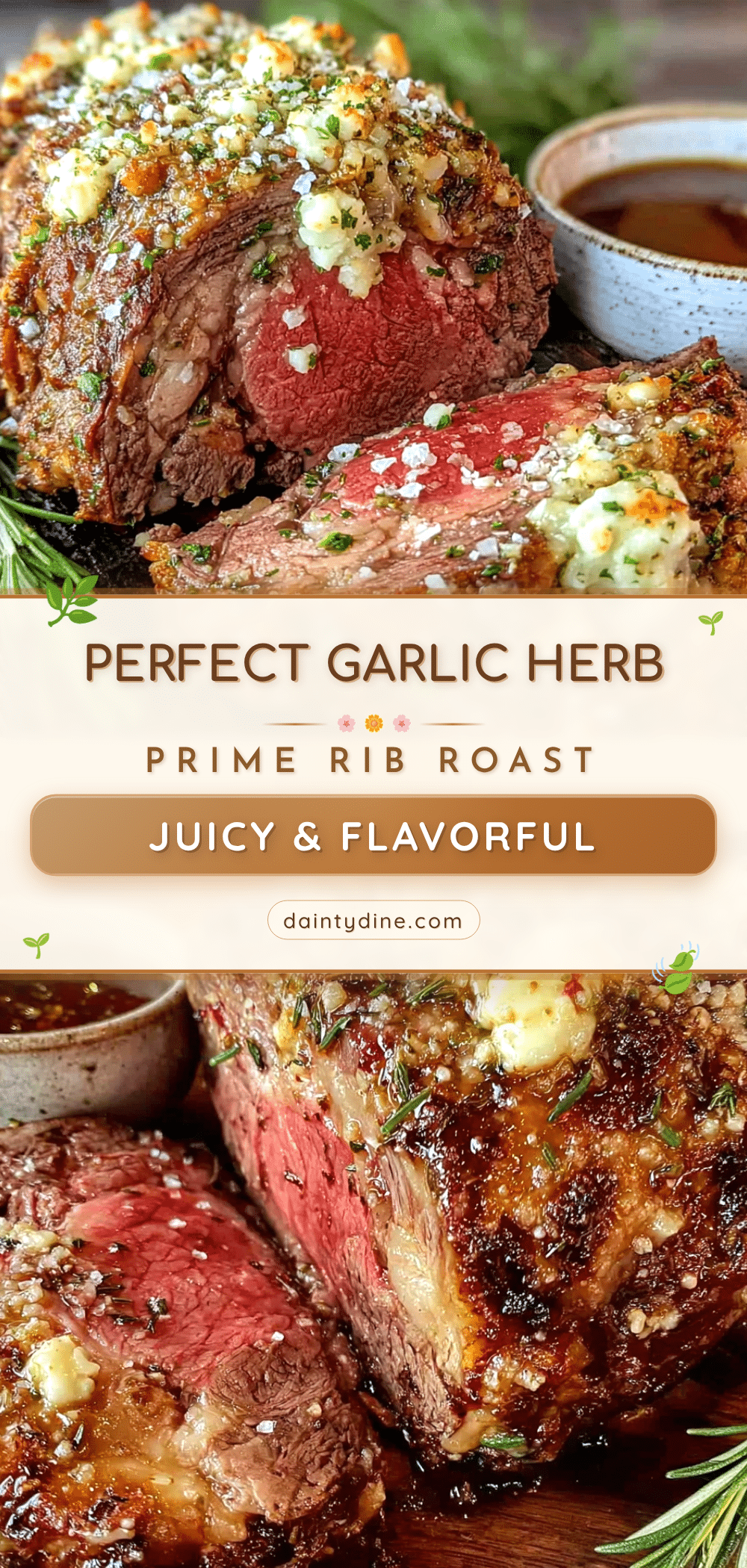
Perfect Garlic Herb Prime Rib Roast: Easy Juicy Recipe
This foolproof garlic herb prime rib roast uses the reverse-sear method for an evenly cooked, juicy interior and a gorgeous golden-brown crust. Made with simple ingredients like garlic, rosemary, and thyme, it’s the perfect centerpiece for holidays and special occasions.
- Prep Time: 20 minutes
- Cook Time: 2 hours 45 minutes
- Total Time: 4 hours 5 minutes (includes resting and final sear)
- Yield: 6-8 servings 1x
- Category: Main Course
- Cuisine: American
Ingredients
- 1/2 cup (113g) unsalted butter, softened
- 6–8 large garlic cloves, minced
- 2 tablespoons fresh rosemary, finely chopped
- 1 tablespoon fresh thyme leaves
- 2 teaspoons kosher salt (Diamond Crystal recommended)
- 1 teaspoon freshly ground black pepper
- 1 tablespoon Dijon mustard
- 4–5 pounds (1.8–2.3 kg) bone-in prime rib roast
- 2 tablespoons olive oil
- Additional kosher salt and black pepper for final seasoning
- 1 cup (240ml) beef broth or red wine
Instructions
- Take the roast out of the fridge 2 hours before cooking. Pat it dry with paper towels.
- Preheat your oven to 250°F (120°C).
- Make the garlic herb butter: In a small bowl, combine softened butter, minced garlic, chopped rosemary, thyme leaves, kosher salt, black pepper, and Dijon mustard. Mash together with a fork until it forms a uniform paste.
- Season the roast: Rub olive oil all over the roast, then massage the garlic herb butter into every surface, including crevices between bones and meat. Let sit for 30 minutes at room temperature if time allows.
- Place the roast bone-side down on a rack in a roasting pan. Pour beef broth or red wine into the bottom of the pan (not over the roast).
- Roast low and slow: Cook until internal temperature reaches 115-120°F (46-49°C) for medium-rare, about 2.5 to 3 hours for a 4-5 pound roast. Start checking temperature after 2 hours.
- Rest the roast (first rest): Remove from oven, tent loosely with foil, and let rest for 20-30 minutes. Internal temperature will rise 5-10°F during this time.
- Crank up the heat: Increase oven temperature to 500°F (260°C) or 475°F (245°C) if oven runs hot.
- The final sear: Remove foil from roast and place back in oven, uncovered. Roast for 8-12 minutes until deep golden-brown crust forms. Watch closely to avoid burning.
- Second rest: Remove from oven, tent again with foil, and let rest for another 10-15 minutes.
- Carve and serve: Transfer to cutting board. Cut bones away from meat in one piece. Slice meat against the grain into 1/2-inch thick slices. Arrange on platter and spoon pan juices over the top.
Notes
For best results, salt the roast the night before and leave uncovered in the fridge. Always use a meat thermometer to avoid overcooking. Let the roast rest twice: once after low-temperature cooking and once after the final sear. The internal temperature will rise 5-10°F during resting (carryover cooking). For a dairy-free version, use vegan butter or olive oil. For a lower-sodium version, reduce salt in herb butter.
Nutrition
- Serving Size: 6 ounces (170g) with
- Calories: 475
- Sodium: 580
- Fat: 32
- Saturated Fat: 14
- Carbohydrates: 2
- Protein: 42
Keywords: prime rib, garlic herb prime rib, reverse sear prime rib, holiday roast, beef roast, Christmas dinner, New Year's Eve dinner, Easter dinner