Love this? Save it for later!
Share the inspiration with your friends
My brother claimed to hate lasagna for fifteen years. Fifteen years. He’d poke at it at family dinners, push the layers around his plate like he was searching for evidence of a crime. “Too heavy,” he’d say. “Too much going on.” I stopped making it for him altogether. Then last October, I made this butternut squash lasagna with sage brown butter on a whim—strictly for myself, I told everyone. It was a Tuesday. I was tired of the same old rotation. I figured I’d have leftovers for the week. I pulled it out of the oven, let it rest, and turned around to grab a glass of wine. When I turned back, my brother was standing at the counter with a fork. He’d already cut himself a corner piece. “What is this?” he asked, mouth half-full. And honestly? I just smiled. I didn’t say a word.
That’s the thing about this cozy butternut squash lasagna with sage brown butter. It doesn’t announce itself. It doesn’t try to convince you. It just sits there, all those creamy, nutty, savory layers, quietly doing its thing. And then someone who swore off lasagna for a decade and a half is standing in your kitchen, eating it cold from the pan. Maybe you’ve been there—the recipe that proves you wrong without even trying. This one did it for me. It did it for him. And it’s been my go-to fall and winter comfort dish ever since.
The first time I made it, I forgot to salt the ricotta. Honest mistake. I was rushing, distracted by the browning butter (which, let me tell you, goes from perfect to burnt in about twelve seconds). But even with that oversight, the lasagna was something special. The sweetness of the roasted squash, the deep, nutty richness of the sage brown butter, the way the bechamel soaked into the no-boil noodles like a warm blanket. It stayed with me. I made it again the next week, properly this time. And again the week after that. Some recipes are just worth repeating until you get them exactly right.
Why You’ll Love This Recipe
This cozy butternut squash lasagna with sage brown butter isn’t your average lasagna. It’s the kind of dish that feels both special and totally doable on a random Wednesday night. Here’s why it keeps showing up in my kitchen year after year:
- Seasonal Perfection: Made for fall and winter, when butternut squash is at its sweetest and sage is abundant. It’s the taste of the season in every single bite.
- No-Boil Noodles: Saves you a whole step. The noodles cook right in the sauce as the lasagna bakes, which means less mess and less stress.
- Rich, Not Heavy: The sage brown butter and creamy bechamel give you that indulgent feel without weighing you down. It’s comfort food that lets you breathe.
- Make-Ahead Friendly: Assemble it the day before, pop it in the fridge, and bake it when you’re ready. Perfect for holiday prep or busy weekends.
- Impress Without Stress: This looks like something from a fancy restaurant, but honestly? It’s just layered noodles and roasted squash. You can do this.
What makes this recipe different from the rest is the brown butter. Most squash lasagnas rely on heavy cream or tons of cheese to carry the flavor. This one lets the squash shine, with the brown butter adding this deep, almost nutty undertone that sage just amplifies. It’s not trying to hide behind a wall of mozzarella. It’s confident in its own flavor profile. And that confidence? It translates to the plate.
I’ve tested this recipe at least a dozen times. I’ve made it for Thanksgiving dinner, for lazy Sunday suppers, for a dinner party where I pretended I hadn’t made it a hundred times before. It always gets the same reaction: the quiet pause after the first bite, followed by “Wait, what’s in this?” That’s the moment. That’s why I keep making it.
What Ingredients You Will Need
This recipe uses simple, wholesome ingredients that come together to create something truly special. Most of these are pantry staples or easy to find at any grocery store, especially during the fall and winter months. Let’s walk through what you’ll need.
For the Roasted Butternut Squash
- 1 medium butternut squash, about 2 ½ to 3 pounds (peeled, seeded, and cut into 1-inch cubes) — Look for squash that feels heavy for its size with a firm, unblemished skin. I prefer organic when I can find it, but conventional works just fine.
- 2 tablespoons olive oil — A good-quality extra virgin olive oil adds a subtle fruitiness that complements the squash.
- ½ teaspoon salt — I use fine sea salt for even seasoning.
- ¼ teaspoon black pepper — Freshly ground is always better.
For the Sage Brown Butter Sauce

- ½ cup unsalted butter (1 stick) — Unsalted gives you control over the salt level. I recommend a good European-style butter like Plugrà or Kerrygold for richer flavor.
- 12-15 fresh sage leaves — The sage will crisp up in the butter and get folded into the sauce. Don’t use dried sage here—it won’t give you the same texture or flavor.
- 3 tablespoons all-purpose flour — This thickens the bechamel. You can substitute with a gluten-free all-purpose blend if needed.
- 3 cups whole milk — Whole milk gives the creamiest result. You can use 2% in a pinch, but the sauce won’t be as luxurious.
- ½ teaspoon salt
- ¼ teaspoon nutmeg — Freshly grated if you have it. It makes a difference.
- ¼ teaspoon black pepper
For the Ricotta Mixture
- 2 cups whole milk ricotta cheese — Full-fat ricotta is non-negotiable here. The low-fat versions get grainy when baked. I like Calabro or BelGioioso.
- 1 large egg — Helps bind the ricotta mixture.
- ½ cup grated Parmesan cheese — Freshly grated from a block, not the stuff in the green can. Trust me on this.
- ¼ teaspoon salt
- ¼ teaspoon black pepper
- Pinch of nutmeg
For Assembly
- 12 no-boil lasagna noodles — Barilla and De Cecco both make good ones. You don’t need to cook them first—they absorb moisture from the sauce as the lasagna bakes.
- 2 cups shredded mozzarella cheese — Shred it yourself from a block. Pre-shredded cheese has anti-caking agents that prevent it from melting smoothly.
- ½ cup grated Parmesan cheese — For the top layer.
- Fresh sage leaves for garnish — Optional but pretty.
If you’re dairy-free, you can substitute the butter with a high-quality vegan butter (Miyoko’s is my go-to), use oat milk for the bechamel, and swap the cheeses with your favorite plant-based alternatives. The texture will be slightly different, but the flavor will still be delicious.
Equipment Needed
You don’t need a ton of fancy equipment for this cozy butternut squash lasagna with sage brown butter. Here’s what I use:
- 9×13-inch baking dish — Glass or ceramic works best. Metal can react with the acidity in the cheese. I’ve had my Pyrex dish for years and it’s never let me down.
- Large rimmed baking sheet — For roasting the squash. Half-sheet pans are perfect. Line it with parchment paper for easy cleanup.
- Medium saucepan — For making the sage brown butter sauce. A light-colored pan helps you see when the butter is browning.
- Large skillet or sauté pan — Optional, but I like to quickly sauté the roasted squash with a little brown butter before layering. Adds depth.
- Chef’s knife and cutting board — A sharp knife makes cutting the squash much safer and easier.
- Vegetable peeler — For peeling the squash. A Y-shaped peeler is my favorite.
- Mixing bowls — One large, one medium.
- Whisk — For the bechamel sauce.
- Wooden spoon or silicone spatula — For stirring.
- Measuring cups and spoons
If you don’t have a 9×13 dish, you can use two 8×8 dishes and adjust the layers accordingly. The baking time will be slightly shorter, so start checking at 35 minutes. Also, a good microplane is worth its weight in gold for grating the nutmeg and Parmesan. They’re cheap and last forever.
Preparation Method
Let’s make this cozy butternut squash lasagna with sage brown butter. I’ll walk you through every step.
Step 1: Roast the Squash
Preheat your oven to 400°F (200°C). Line a large baking sheet with parchment paper. Toss the cubed butternut squash with olive oil, salt, and pepper. Spread it in a single layer—don’t overcrowd, or it’ll steam instead of roast. Roast for 25-30 minutes, flipping halfway through, until the squash is tender and lightly caramelized around the edges. The edges should be golden brown and slightly crispy. Remove from the oven and set aside. Leave the oven on.
Step 2: Make the Sage Brown Butter Sauce
While the squash roasts, start the sauce. In a medium saucepan over medium heat, melt the butter. Add the fresh sage leaves. Cook, stirring occasionally, until the butter turns a deep golden brown and smells nutty—about 5-7 minutes. The sage leaves will crisp up. Watch closely; brown butter can go from perfect to burnt in seconds. When the butter is golden and the sage is crispy, use a slotted spoon to remove the sage leaves and set them aside. Keep the brown butter in the pan.
Whisk the flour into the brown butter to form a paste. Cook for 1 minute, stirring constantly. This removes the raw flour taste. Gradually pour in the milk, whisking continuously to prevent lumps. Bring the mixture to a gentle simmer. Cook for 3-5 minutes, stirring often, until the sauce thickens enough to coat the back of a spoon. Stir in the salt, nutmeg, and pepper. Taste and adjust seasoning. Remove from heat.
Step 3: Prepare the Ricotta Mixture
In a medium bowl, combine the ricotta, egg, Parmesan, salt, pepper, and a pinch of nutmeg. Mix until smooth. Set aside.
Step 4: Mash the Roasted Squash
Once the squash is cool enough to handle, transfer it to a large bowl. Mash it roughly with a fork or potato masher. You want it mostly smooth but with some chunks remaining for texture. Stir in about ½ cup of the brown butter sauce to loosen it up. Crumble the reserved crispy sage leaves and stir them in too. This is where the magic happens.
Step 5: Assemble the Lasagna
Reduce the oven temperature to 375°F (190°C). Spread a thin layer of the brown butter sauce (about ½ cup) on the bottom of your 9×13 baking dish. This prevents the noodles from sticking. Layer 3 no-boil lasagna noodles on top, slightly overlapping. Spread one-third of the mashed squash mixture over the noodles. Dollop one-third of the ricotta mixture on top and spread gently. Sprinkle with ½ cup mozzarella and 2 tablespoons Parmesan. Repeat the layers two more times: noodles, squash, ricotta, mozzarella, Parmesan. For the final layer, top with the remaining 3 noodles, the rest of the brown butter sauce, and the remaining mozzarella and Parmesan. The sauce should cover the noodles completely—this is what hydrates them.
Step 6: Bake
Cover the dish tightly with foil. Bake for 35 minutes. Remove the foil and bake for another 15-20 minutes, until the top is golden and bubbly and the edges are crispy. Let it rest for at least 15 minutes before slicing. This is crucial—if you cut too soon, the lasagna will slide apart. Trust the rest.
Cooking Tips & Techniques
I’ve made this cozy butternut squash lasagna with sage brown butter enough times to learn a few things the hard way. Here’s what I wish someone had told me.
Don’t rush the brown butter. I know it’s tempting to crank up the heat, but medium heat is your friend. The butter needs time to go through its stages—melt, foam, bubble, then turn golden. Swirl the pan occasionally. When you see brown specks forming at the bottom and it smells like toasted nuts, you’re there. Pull it off the heat immediately. I’ve burned more batches than I care to admit.
Season as you go. This is the single biggest mistake home cooks make with lasagna. If you only season the top layer, the inside will taste flat. Salt the squash before roasting. Season the ricotta. Season the bechamel. Every layer should be seasoned individually. Your taste buds will thank you.
Let the lasagna rest. I know you’re hungry. I know it smells incredible. But if you cut into it right out of the oven, you’ll get a soupy mess. The lasagna needs time to set so the sauce can absorb into the noodles and everything can firm up. Fifteen minutes minimum. I usually let it rest for 20-25 minutes while I set the table and pour the wine.
Use a serrated knife to slice. A chef’s knife will drag the top layer of cheese off. A serrated knife cuts cleanly through the noodles without pulling. Run it under hot water between cuts for even cleaner slices.
Toast the sage leaves separately if they don’t crisp up. Sometimes the sage leaves in the brown butter don’t get fully crispy. No problem. Just fry a few extra leaves in a small pan with a tablespoon of butter for 30 seconds per side. They’ll be perfectly crunchy and make a beautiful garnish.
Variations & Adaptations
This cozy butternut squash lasagna with sage brown butter is forgiving. Here are some ways to make it your own.
Vegetarian and Hearty: Add a layer of sautéed mushrooms (cremini or shiitake) between the squash and ricotta. Earthy mushrooms pair beautifully with the sage and brown butter. I’ve done this for Thanksgiving and it was a hit with the vegetarians at the table.
Add Protein: Layer in some shredded rotisserie chicken or crumbled Italian sausage (cooked and drained) for a heartier version. I’ve made it with spicy sausage and the contrast with the sweet squash is fantastic.
Gluten-Free: Use gluten-free no-boil lasagna noodles. I’ve tested this with Tinkyada brand and it works perfectly. Just make sure your bechamel is thick enough—gluten-free noodles sometimes need a little extra moisture.
Lighter Version: Swap the whole milk for 2% and use part-skim ricotta. You can also reduce the mozzarella to 1 ½ cups. The texture will be slightly less creamy, but the flavor will still be there.
Add Greens: Wilt a few handfuls of spinach or kale and layer it in. I’ve done this when I wanted to pretend the lasagna was healthy. It works. Just squeeze the excess moisture out of the greens first.
Spicy Kick: Add a pinch of red pepper flakes to the brown butter sauce. The heat cuts through the richness and adds an unexpected layer of flavor. I discovered this by accident when I dropped a flake in and decided to leave it.
Serving & Storage Suggestions
This cozy butternut squash lasagna with sage brown butter is best served warm, not piping hot. Let it rest, then slice into generous squares. I like to serve it with a simple arugula salad dressed with lemon and olive oil—the peppery greens cut through the richness perfectly. A glass of crisp white wine like a Sauvignon Blanc or a light Pinot Noir works beautifully.
For presentation, garnish with a few fresh sage leaves and a sprinkle of flaky sea salt. The salt adds a lovely crunch and brightens all the flavors. I also like to drizzle a tiny bit of extra brown butter on top if I have any left over.
Storage: Leftovers keep in the refrigerator for up to 4 days. Cover the dish tightly with foil or transfer individual portions to airtight containers. The flavors actually get better on the second day as everything melds together.
Freezing: This lasagna freezes beautifully. Assemble it completely but don’t bake it. Wrap the dish tightly in plastic wrap, then foil, and freeze for up to 3 months. To bake from frozen, remove the plastic wrap, cover with foil, and bake at 375°F for 60 minutes. Remove the foil and bake for another 20 minutes until bubbly. You can also freeze baked leftovers in individual portions for quick lunches.
Reheating: The best way to reheat is in the oven at 350°F for 15-20 minutes. The microwave works in a pinch, but the noodles can get mushy. If you’re reheating a single slice, a toaster oven is perfect.
Nutritional Information & Benefits
This cozy butternut squash lasagna with sage brown butter is comfort food, but it also has some redeeming qualities. Here’s a rough estimate per serving (based on 8 servings):
- Calories: Approximately 480-520
- Protein: 22g
- Fat: 28g
- Carbohydrates: 42g
- Fiber: 4g
- Sugar: 8g
- Sodium: 680mg
Butternut squash is packed with vitamin A (one serving gives you over 100% of your daily needs) and vitamin C. It’s also a good source of fiber and potassium. The sage in this recipe isn’t just for flavor—it has antioxidant properties and has been used in traditional medicine for digestion. The brown butter? Well, it’s butter. But it makes you happy, and that counts for something.
This recipe is vegetarian as written. For gluten-free, use the noodles I mentioned in the variations. It contains dairy, so it’s not suitable for vegans, but you can adapt it with plant-based alternatives.
Conclusion
This cozy butternut squash lasagna with sage brown butter is more than a recipe. It’s the dish I turn to when I want to feed people something that feels like a hug. It’s the dish that converted my brother after fifteen years of lasagna refusal. It’s the dish that makes people close their eyes on the first bite and forget what they were talking about.
I hope you make it your own. Maybe you’ll add mushrooms. Maybe you’ll skip the ricotta and double the bechamel. Maybe you’ll serve it for Christmas dinner or a random Tuesday when you just need something warm and good. However you make it, I think you’ll love it. And if someone at your table says they don’t like lasagna? Just smile. Make this. Let the lasagna do the talking.
If you try this recipe, I’d love to hear about it. Leave a comment below, tag me in your photos, or tell me how you made it your own. Happy cooking, friends. Here’s to cozy nights and good food.
Frequently Asked Questions
Can I use frozen butternut squash instead of fresh?
Yes, you can. Thaw it completely and pat it dry with paper towels to remove excess moisture before roasting. The texture won’t be quite as caramelized, but it’ll still taste great. Just know that fresh squash gives you better flavor and texture.
Do I really need to use no-boil noodles?
You can use regular lasagna noodles if you prefer. Just boil them according to the package directions until al dente, then drain and lay them flat on a baking sheet to prevent sticking. No-boil noodles save time and are less fussy, but regular noodles work too.
Can I make this lasagna ahead of time?
Absolutely. Assemble the lasagna completely, cover it tightly with foil, and refrigerate for up to 24 hours. When you’re ready to bake, add about 10 minutes to the covered baking time since you’re starting from cold. This is actually my preferred method—the flavors meld together beautifully overnight.
Why did my bechamel sauce turn out lumpy?
Lumpy bechamel usually happens when you add the milk too quickly or don’t whisk constantly. If you end up with lumps, don’t panic. Pour the sauce through a fine-mesh strainer into a clean bowl. It’ll be smooth again. Or use an immersion blender to smooth it out right in the pan.
How do I know when the lasagna is fully baked?
The lasagna is done when the top is golden brown and bubbly, and the edges are crispy. You can also insert a knife into the center—it should slide through the noodles easily with no resistance. If the top is browning too quickly but the center isn’t done, cover it with foil for the remaining bake time.
Pin This Recipe!
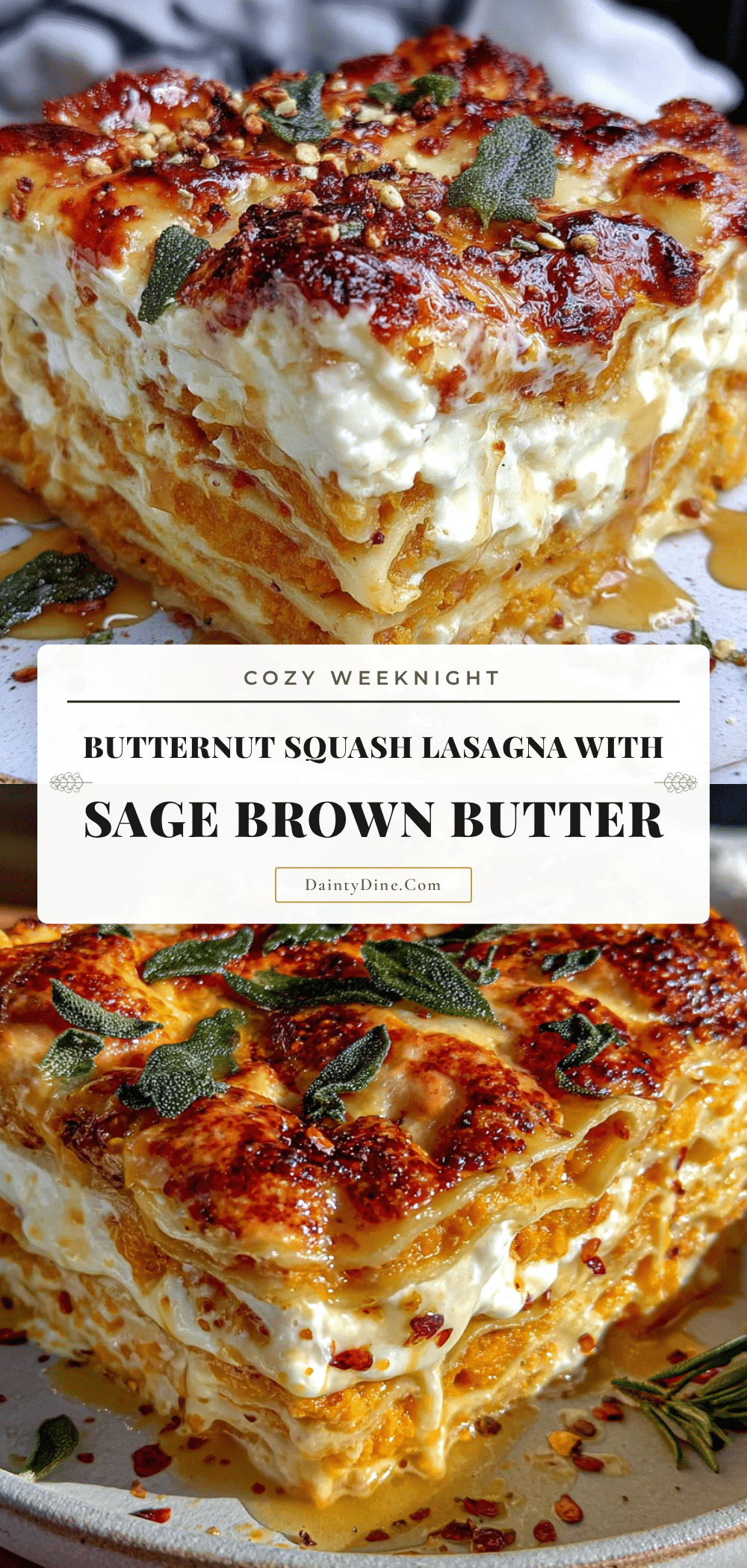
Easy Cozy Butternut Squash Lasagna with Sage Brown Butter
A creamy, nutty, and savory lasagna featuring roasted butternut squash, sage brown butter bechamel, and a rich ricotta mixture. This comforting dish is perfect for fall and winter, and it’s so good it might just convert even the most stubborn lasagna skeptics.
- Prep Time: 30 minutes
- Cook Time: 1 hour 10 minutes
- Total Time: 1 hour 40 minutes
- Yield: 8 servings 1x
- Category: Main Course
- Cuisine: Italian-American
Ingredients
- 1 medium butternut squash, about 2 ½ to 3 pounds, peeled, seeded, and cut into 1-inch cubes
- 2 tablespoons olive oil
- ½ teaspoon salt
- ¼ teaspoon black pepper
- ½ cup unsalted butter (1 stick)
- 12–15 fresh sage leaves
- 3 tablespoons all-purpose flour
- 3 cups whole milk
- ½ teaspoon salt
- ¼ teaspoon nutmeg
- ¼ teaspoon black pepper
- 2 cups whole milk ricotta cheese
- 1 large egg
- ½ cup grated Parmesan cheese
- ¼ teaspoon salt
- ¼ teaspoon black pepper
- Pinch of nutmeg
- 12 no-boil lasagna noodles
- 2 cups shredded mozzarella cheese
- ½ cup grated Parmesan cheese
- Fresh sage leaves for garnish (optional)
Instructions
- Preheat oven to 400°F (200°C). Line a large baking sheet with parchment paper. Toss cubed butternut squash with olive oil, salt, and pepper. Spread in a single layer and roast for 25-30 minutes, flipping halfway, until tender and lightly caramelized. Remove from oven and set aside. Leave oven on.
- While squash roasts, make the sage brown butter sauce. In a medium saucepan over medium heat, melt the butter. Add fresh sage leaves. Cook, stirring occasionally, until butter turns deep golden brown and smells nutty, about 5-7 minutes. Use a slotted spoon to remove crispy sage leaves and set aside. Keep brown butter in pan.
- Whisk flour into brown butter to form a paste. Cook for 1 minute, stirring constantly. Gradually pour in milk, whisking continuously. Bring to a gentle simmer and cook for 3-5 minutes, stirring often, until sauce thickens enough to coat the back of a spoon. Stir in salt, nutmeg, and pepper. Remove from heat.
- In a medium bowl, combine ricotta, egg, Parmesan, salt, pepper, and a pinch of nutmeg. Mix until smooth. Set aside.
- Once squash is cool enough to handle, transfer to a large bowl. Mash roughly with a fork or potato masher, leaving some chunks. Stir in about ½ cup of the brown butter sauce. Crumble reserved crispy sage leaves and stir in.
- Reduce oven temperature to 375°F (190°C). Spread a thin layer of brown butter sauce (about ½ cup) on the bottom of a 9×13-inch baking dish. Layer 3 no-boil lasagna noodles on top, slightly overlapping. Spread one-third of the mashed squash mixture over noodles. Dollop one-third of ricotta mixture on top and spread gently. Sprinkle with ½ cup mozzarella and 2 tablespoons Parmesan. Repeat layers two more times: noodles, squash, ricotta, mozzarella, Parmesan. For final layer, top with remaining 3 n…
- Cover dish tightly with foil. Bake for 35 minutes. Remove foil and bake for another 15-20 minutes, until top is golden and bubbly and edges are crispy. Let rest for at least 15 minutes before slicing.
Notes
Don’t rush the brown butter; medium heat is key. Season each layer individually. Let lasagna rest at least 15 minutes before slicing. Use a serrated knife for clean slices. If sage leaves don’t crisp up, fry extra leaves separately. For make-ahead, assemble and refrigerate up to 24 hours; add 10 minutes to covered baking time. Freezes well unbaked for up to 3 months.
Nutrition
- Serving Size: 1 slice (1/8 of lasa
- Calories: 500
- Sugar: 8
- Sodium: 680
- Fat: 28
- Saturated Fat: 16
- Carbohydrates: 42
- Fiber: 4
- Protein: 22
Keywords: butternut squash lasagna, sage brown butter, fall lasagna, winter lasagna, vegetarian lasagna, comfort food, holiday lasagna